Studio note · General
Steaming Iron Machine Guide: Types, Features and Safety
Compare steaming iron machine types, wattage, steam output, safety features and descaling so you can choose the right model for your laundry.
- Updated
- November 27, 2026
- Reading
- 13 min
The most repeated advice about buying a steaming iron machine is to chase the highest wattage and the largest steam figure on the box. That advice is easy to follow and mostly wrong. Wattage describes what the heating element draws from the wall socket, and a headline steam number describes output under one set of conditions, not how well the appliance handles a linen shirt collar or four layers of denim.
What separates a frustrating iron from a capable one is quieter: the pressure design, the descaling design and the amount of control over heat and contact. Those three decide whether steam reaches the middle of a fibre bundle, whether the appliance still performs in month eighteen, and whether a delicate garment survives the session.
Table of Contents
- Steam Iron Types and How Steam Reaches Fabric
- Wattage and Steam Output Explained Side by Side
- Key Features to Compare Beyond Steam Output
- Auto Shut-Off and Safe Use Rules
- Descaling and Water Care Routine
- Common Faults and Their Fixes
- Choose the Right Steam Iron Before Comparing Models
Steam Iron Types and How Steam Reaches Fabric
A vented steam iron suits routine pressing of shirts, school uniforms and bed linen. A pressurized iron or steam-generator station becomes more useful when sessions are long or fabrics are dense and layered. The distinction starts with where steam forms and how it reaches the plate.
A kettle and a pressure cooker offer a useful comparison. The kettle releases steam at atmospheric pressure. The cooker contains steam under pressure. Vented and pressurized irons follow that broad distinction, although fabric remains outside the boiler. The comparison explains steam delivery, not a guarantee that steam will pass through every layer.
Three designs cover the main household choices.
| Type | How it makes steam | Best for | Main trade-off |
|---|---|---|---|
| Vented steam iron | Water enters a heated chamber behind the soleplate, while the reservoir remains at atmospheric pressure | Everyday cotton, polyester and light pressing | Less force available to deliver steam into thick or multilayer fabric |
| Pressurized steam iron | A boiler generates steam under pressure and supplies it to the soleplate | Heavy cotton, linen, denim and dense or layered fabric | Heavier body and usually a higher price |
| Steam-generator station | A separate boiler supplies steam through a hose to a flat-plate iron | Sewing rooms, tailoring and long daily sessions | Bulky footprint and more setup than a handheld iron |
The separate boiler is the station's defining feature. It changes the arrangement of the appliance, while the handheld plate still provides direct contact with the cloth. A larger setup therefore needs to suit the workload, not promise more steam.
How Steam Travels From Tank to Fibre
The basic path is water, heat, steam and contact. The location of the heated chamber differs between designs.
- Water leaves the tank. Gravity or a pump feeds water into a heated chamber. In a vented iron, that chamber sits behind the soleplate. A station generates steam in its separate boiler.
- Heat turns it into vapour. The chamber needs enough heat to vaporise the incoming water rather than let it pool. Water that remains liquid can emerge as spitting or droplets.
- Vapour escapes through the soleplate. Small apertures distribute steam over the cloth. Their arrangement shapes coverage, so the steam supply and the plate work together.
- Steam penetrates while the plate presses. Moisture helps relax fibres. Heat and downward pressure shape the fabric, which holds that shape as it cools.
Pressure influences how steam is delivered through the apertures. A pressurized design can be useful for demanding cloth, but pressure alone does not establish how evenly steam reaches a layered garment. Steam delivery and plate contact both matter.
Steam output is measured under standardized test conditions in the IEC 60311 standard. Comparable measurements are more useful than descriptions such as “powerful steam,” which leave the operating conditions unclear.
Rule of thumb: a pressure comparison should distinguish continuous working pressure from a peak value. Steam-rate figures should also use the same measurement conditions.
The final step explains why a flat-plate iron can beat a vertical steamer. Steam helps loosen wrinkles, but contact supplies control over the finish. A plate pressed against a shirt collar or fabric edge can shape a defined line. Steam directed at hanging cloth can smooth wrinkles without providing that same pressing action.
For this reason, pressure design, descaling design and control over contact deserve attention before headline output. Extra steam cannot replace the flat plate when the job calls for a crisp edge.
Wattage and Steam Output Explained Side by Side
Wattage measures electricity drawn by the heating element. It does not measure how much steam reaches the fabric. A steam iron specification guide makes the split plainly: steam output depends on the pump or gravity feed, the vaporisation chamber and the arrangement of holes in the soleplate, none of which the wattage figure describes.
That's why two irons rated at 1,600 W can behave nothing alike at the board.
| Specification | Everyday household iron | High-output model | What it tells you |
|---|---|---|---|
| Heating element wattage | 1,400 to 1,600 W | 1,700 to 2,000 W | Electricity drawn by the heater, not steam delivered |
| Continuous steam output | 20 to 30 g/min | 35 to 45 g/min | Steam reaching the fabric, the figure that matters for heavy cloth |
| Pressure design | Vented in many models | Pressurized in many models | How hard steam is pushed into dense fabric |
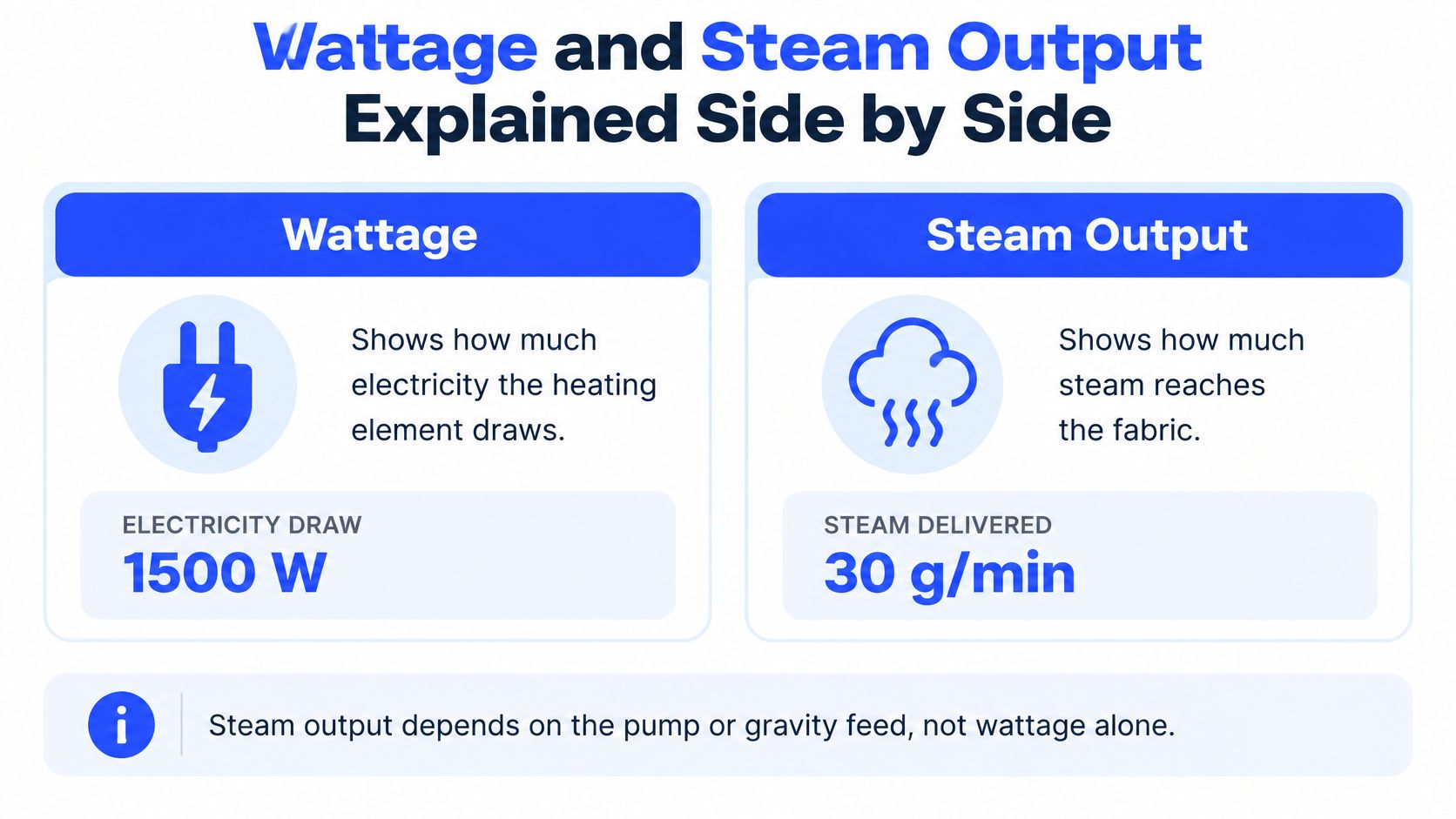
The practical reading is workload. A household pressing one shirt a day sits comfortably inside the 20 to 30 g/min band, and paying for more output buys nothing except a heavier body. A family working through thick towels, denim and heavy linen gains from the 35 to 45 g/min range, because more steam per minute means fewer passes over the same seam.
Wattage still matters, just for a different job. Higher wattage shortens recovery time, the seconds an iron needs to climb back to temperature after a burst of steam cools the plate. That affects rhythm on a long session and matters little on a single collar.
The Specification Listings Leave Out
Reservoir capacity rarely appears in the headline block of a product listing, and it decides how often the session stops for a refill. A small tank on a high-output iron is a strange combination: fast steam, frequent interruptions. Where the capacity isn't printed, the manufacturer's manual usually states it.
A useful habit before comparing prices is to write three numbers down for every shortlisted model: continuous steam output in grams per minute, pressure design (vented or pressurized), and reservoir size. Those three answer most of the question. The wattage badge answers the smallest part of it.
Key Features to Compare Beyond Steam Output
Before comparing prices, check soleplate material, temperature control, cord length, weight and tank access. These decide daily comfort as much as any steam figure, and none of them shows up in a marketing headline.
| Feature | What to check | Why it matters |
|---|---|---|
| Soleplate material | Material named in the manual or spec sheet | Affects glide over fabric and how residue builds up |
| Temperature control | Number of settings and the fabric labels they match | Lets the user match heat to cotton, linen or synthetic fibres |
| Cord length | Stated length in metres | Reach from the board to the socket without strain |
| Weight | Stated weight | Affects hand fatigue in long sessions |
| Tank access | Fill opening size and whether the tank is removable | Eases refilling and cleaning with hard water |
Soleplate material deserves more attention than it gets. A plate that glides cleanly needs less downward force, and less force means less shine on dark wool and fewer stretched bias seams. Residue sticks to scratched or pitted surfaces faster, which turns a small maintenance issue into a staining problem.
Temperature control is a fabric-matching tool, not a convenience. An iron with five labelled settings lets the user drop to a low band for a polyester blend and climb for linen without guessing at dial positions.
A narrow ironing board changes the answer. It needs a stable base that doesn't rock and a cord long enough to reach the socket without pulling the iron sideways mid-stroke.
Tank access is the feature owners notice last and curse most. A small fill opening under a fixed spout turns a thirty-second refill into a kitchen-counter job, and a removable tank makes rinsing out hard-water residue far easier.
Every figure in a comparison table has to come from the manufacturer's specification sheet or the seller's own product page, linked so a reader can verify it. Numbers copied from a marketplace summary are the ones that go stale fastest. A product comparison chart built on documented specifications keeps those values in one place instead of scattered across tabs.
Auto Shut-Off and Safe Use Rules
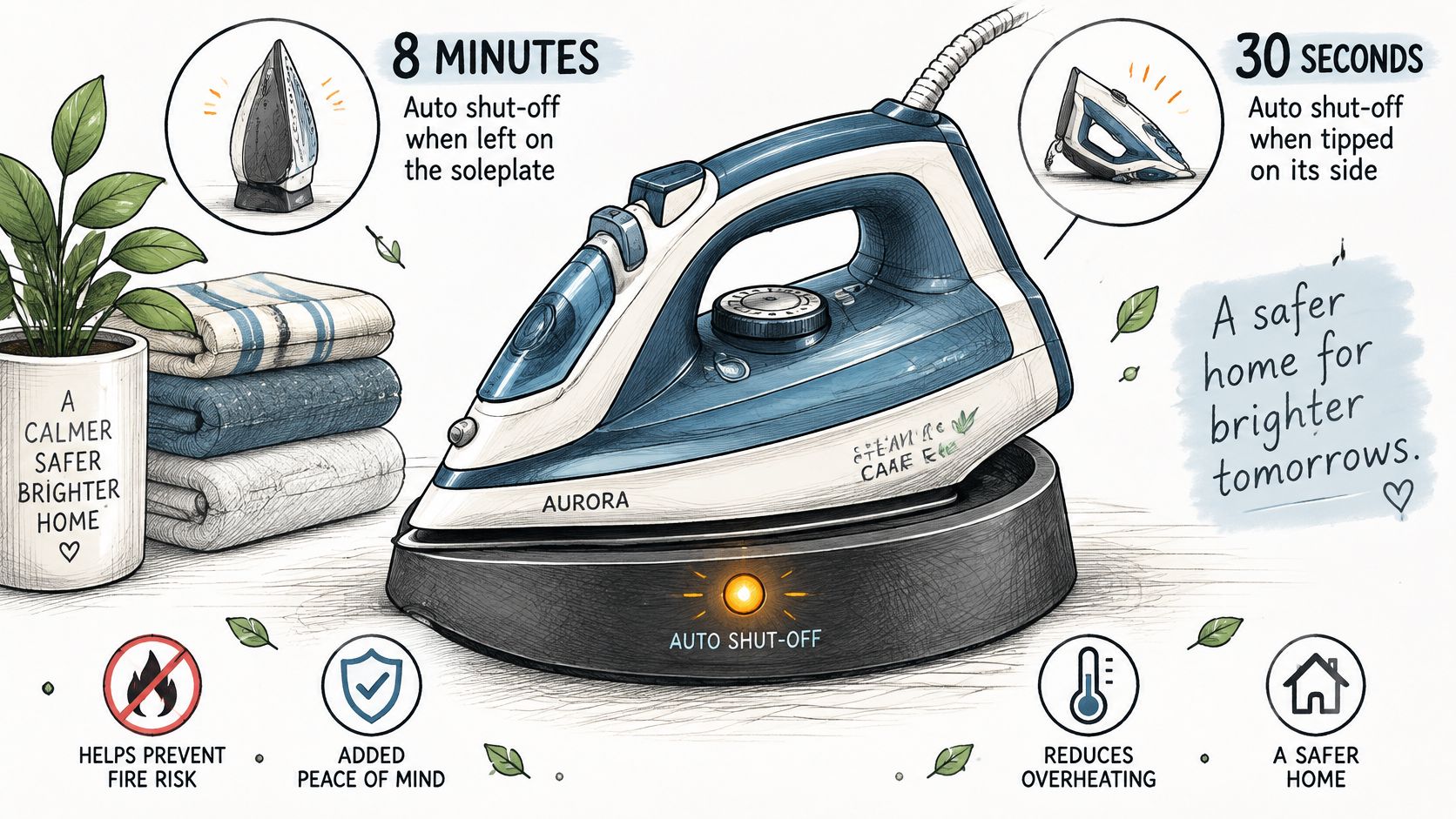
Automatic shut-off is a measurable feature, and its timing varies by model. Tefal's published instructions state that the auto-stop system cuts power and flashes an indicator when the iron stays on its support base for more than 8 minutes, or when it is left flat for more than 30 seconds, according to Tefal's instruction booklet. Other brands set different limits, so the phrase "auto shut-off" on a box tells a buyer almost nothing until the manual supplies the numbers.
The standing and flat positions matter separately. An iron parked upright on its heel during a phone call is in one state; an iron face-down on the board is in another. Check both.
Habits Auto Shut-Off Doesn't Replace
The timer is a backstop, not a substitute for switching off. Singapore's Consumer Product Safety Office instructs users to unplug a steam iron before refilling its container, never leave an iron unattended while it's connected to mains power, and disconnect it after use. Those three rules cover the failures a timer can't prevent.
Consider two ordinary scenes. An iron left on the board while the doorbell is answered sits flat, heating the same patch of board cover, until the flat-position timer fires. A hot iron set down on carpet, or a cord trailing across a wet sink edge, puts heat and mains electricity within reach of children and pets. Neither scene involves a malfunction.
The appliance combines a hot soleplate, hot water or steam under pressure and mains electricity in a single handheld object. That combination is why the rules are stricter than for a kettle.
What to Verify Before Buying
- Shut-off times: the stated minutes for the standing position and the seconds for the flat position.
- Coverage: whether auto-stop applies when the iron stands upright, not only when it lies down.
- Cord length: enough reach that the cord never crosses a walkway or a water source.
- Base stability: a support base that doesn't tip when the iron is set down one-handed.
- Cooling time: a stated figure, so storage doesn't happen while the plate is still hot.
Any other brand's limits belong in a comparison only after its own manual has been checked.
Descaling and Water Care Routine
Scale is what's left behind when water evaporates. Minerals stay in the steam chamber, narrow the passages and cut steam output over time, and hard water speeds the process. That's why descaling is a purchase consideration rather than a chore invented by manufacturers.
Philips recommends descaling its steam irons every 1 to 2 months and notes that hard-water areas can see faster buildup, according to Philips' descaling instructions. The published procedure runs in a fixed order: fill the tank, select maximum temperature with steam switched off, then shake the heated iron over a sink so water, steam and scale leave through the vents.
Philips also states that a 50% mixture of demineralized water and tap water may be used in hard-water regions to limit limestone accumulation. That's a manufacturer's allowance, not a universal rule, and some brands restrict demineralized water outright because it can behave differently in their sensors.
The Routine That Keeps Steam Output Steady
- Check local water hardness first. It sets the descaling interval more than the calendar does.
- Descale on the manufacturer's schedule. A monthly cycle in a hard-water area is cheaper than a replacement iron.
- Empty the tank after each session. Standing water leaves deposits exactly where steam has to pass.
- Rinse the anti-calc collector where one is fitted. Some designs include a removable cartridge that traps scale before it reaches the chamber.
- Wipe the soleplate once it's cool. Residue that bakes on takes more than a wipe to shift later.
Confirm the manufacturer's water rules before switching to distilled or demineralized water. Two irons can carry opposite instructions on the same page of two different manuals.
Practical habit: treat the descaling interval as part of the appliance's running cost, not an optional extra.
The cost point is easy to miss at the till. An iron that needs frequent descaling in hard water, with no anti-calc collector and a tank that's awkward to rinse, costs more across its working life in time and consumables than a higher-priced model with easier maintenance. Price tags compare purchase, not ownership.
Common Faults and Their Fixes
Leaking and spitting water is the fault owners report most often, and it's usually a settings or water problem rather than a broken appliance. Limescale buildup reduces steam performance, and residue makes the soleplate harder to use, as Which?'s guide to steam iron faults explains. Most faults fall into five recognisable patterns.
| Symptom | Likely cause | First fix |
|---|---|---|
| Leaks or spits water | Steam setting too high, mineral scale or the wrong water type | Lower the steam setting, descale and refill with water the manual allows |
| Brown or dirty water | Scale or sediment inside the steam chamber | Run the self-clean or descale routine, then empty the tank |
| Weak steam | Limescale restricting the vents | Descale the iron and rinse the anti-calc collector if fitted |
| Staining on fabric | Residue left on the soleplate | Clean the soleplate when cool, following the manual |
| Steam stops after a few minutes | Low water or blocked vents | Refill, descale, and contact the manufacturer if it persists |
The Order to Try Fixes In
Start with the cheapest change. Lowering the steam setting or switching to the water type the manual permits costs nothing and shows a result in the next session, which is the fastest way to rule out user error. Descaling comes second, because a full cycle takes time and a second run if output stays weak afterwards.
Only after those two steps does a warranty claim make sense. A claim filed against an iron that needed a descale wastes weeks and often returns the same machine with the same scale inside it.
Brown water follows its own logic. Sediment and scale sitting in the chamber get picked up by steam and land on light fabric, and the cure is a self-clean or descale cycle followed by emptying the tank rather than a repair. Staining works differently: the mark comes from residue already on the plate, so the fix is cleaning the soleplate once it's cool, following the manual rather than a household abrasive.
One boundary is worth stating plainly. Opening a steam iron exposes mains wiring, a hot element and, on pressurized models, a boiler under pressure. If the symptoms survive a descale and a water change, contact the manufacturer. For a wider look at how appliance comparisons are structured around maintenance and running cost, this breakdown of bagged versus bagless vacuums shows the same reasoning applied to another household machine.
Choose the Right Steam Iron Before Comparing Models
More steam doesn't automatically mean better garment care. The assumption behind most buying advice is that output is the goal, when the actual goal is a garment that looks the way its owner wants. Two different jobs sit inside that goal, and they call for different tools.
Removing wrinkles is one job. Pressing is the other. A flat-plate steam iron creates sharp trouser creases, pressed collars, crisp cuffs and a finished linen edge, because the plate delivers heat and pressure along a defined line. A vertical steamer relaxes fibres without flattening them, which suits hanging garments, structured pieces and anything with surface decoration.
A pleated wool trouser illustrates the first case. It needs firm contact pressure and a plate hot enough to set the fold, and a steamer held at a distance will only soften it. A beaded silk dress illustrates the second. Steam released a few centimetres away lifts the wrinkles while the embellishment never touches a hot surface.
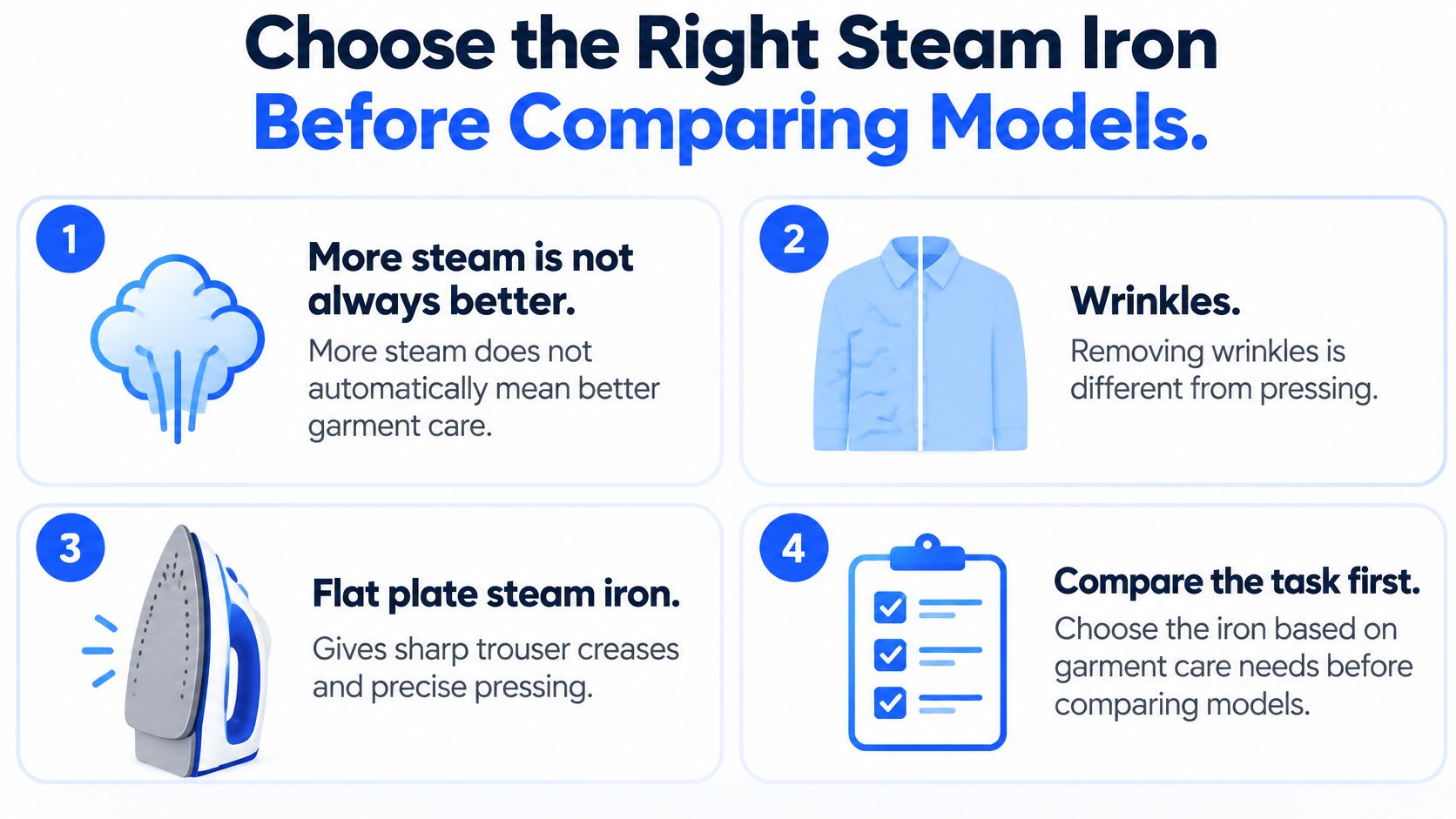
Control, contact pressure, soleplate temperature and technique often outweigh the steam figure. A careful user with a modest iron and a pressing cloth beats a careless user with a station every time. Claims such as "safe for all fabrics" deserve scepticism until the care label agrees.
A Decision Checklist Before Price
- List the garments ironed most. Ten shirts a week and one linen suit point at different machines.
- Decide whether sharp creases matter. Collars, cuffs and trouser folds need a plate.
- Check local water hardness. It sets the descaling burden and the running cost.
- Measure the storage space. A station with a separate boiler needs a permanent home.
- Decide how much descaling will happen. A design that's easy to clean gets cleaned.
Once those answers are fixed, comparing shortlisted models on documented specifications and the seller's current published price is straightforward, and the same method works for other household machines, as this comparison of the best clothes washers shows. Every figure should trace back to a manufacturer sheet or a seller page, and any quoted price should carry the date it was checked.
Comredix publishes independent comparisons built on documented specifications and seller-published prices, so a shortlist can be checked against the numbers that decide daily use rather than the badge on the box. Its rankings apply the same weighted criteria across categories, from home equipment to consumer electronics, and every quoted figure links back to the organisation that published it. Visit Comredix to compare steam irons and the wider range of household products side by side.
Comredix. (2026, November 27). Steaming Iron Machine Guide: Types, Features and Safety. https://comredix.com/steaming-iron-machine
Spotted an error in this guide? Email editorial@comredix.com