Studio note · General
Bagged vs Bagless Vacuum Cleaners: Which Fits Your Home
Compare bagged vs bagless vacuum cleaners on upkeep, running costs, filtration and convenience, with a clear verdict for each type of home.
- Updated
- November 22, 2026
- Reading
- 11 min
The usual advice on bagged vs bagless vacuum cleaners is too simple: buy bagged for allergies and bagless to save money. Neither recommendation settles the buying decision. Dust disposal, performance as the machine fills, and replacement consumables matter more than the label alone.
A vacuum can contain dust well during cleaning yet expose its owner when emptied. Another can avoid disposable bags but need filter care that the household won't keep up with. The useful comparison is between complete machines and their maintenance routines, not competing promises.
Table of Contents
- Bagged and Bagless Vacuums Side by Side
- Allergy and Filtration Depend on the Whole System
- How Suction and Upkeep Change as Each Fills
- The Real Running Cost Beyond the Purchase Price
- Which Format Fits Which Home
- Check These Specs Before You Buy
Bagged and Bagless Vacuums Side by Side
The main difference is where each vacuum puts the work. Bagged models collect debris in a disposable bag; bagless models separate debris from the airflow and store it in a reusable bin. That changes what owners replace, empty and clean.
Bagged and bagless vacuums compared on daily-use criteria
| Factor | Bagged vacuum | Bagless vacuum |
|---|---|---|
| Dust collection | Porous disposable bag holds the dust | Reusable bin collects separated debris |
| Suction as the container fills | Airflow changes as the bag loads | Airflow changes as the bin and filter load; tested evidence shows no general rule favouring either format |
| Dust released when emptying | Bag layers and the seal matter; single-layer bags performed poorly in allergen testing | Careful bin emptying and filter sealing matter |
| Routine upkeep | Replace the bag and check seals and filters | Empty the bin, wash permitted parts, and clean or replace the filter |
| Recurring consumables | Bags and filters | Washable or replacement filters |
| Best fit | Homes prioritising contained disposal and fewer filter cleans | Homes avoiding bag purchases and accepting bin cleaning |
Treat the table as a shortlist filter
These are differences in ownership tasks, not a performance ranking. A bagged model with an awkward bag collar may be harder to maintain than a bagless model with an accessible bin. An easy-release bin, in turn, says nothing about how well the vacuum filters exhaust air.
Disposal and cleaning are separate jobs. Check the bag closure or bin-release mechanism, then look at access to the filter compartment. Product photographs can show where parts sit; the manual explains which parts can be washed.
Practical rule: Choose an acceptable disposal routine before comparing convenience features.
Bag construction, airflow sealing, filter condition and handling all affect the result. The format label can narrow the shortlist, but it cannot identify a winner on every measure. Use the table to find which tasks suit the household's cleaning habits and dust load. A vacuum that removes one unwelcome chore is a poor fit if its replacement maintenance is likely to be neglected.
Allergy and Filtration Depend on the Whole System
A bag isn't a clean-air guarantee. It describes where debris collects, not whether every joint, filter and exhaust opening prevents particles from escaping.
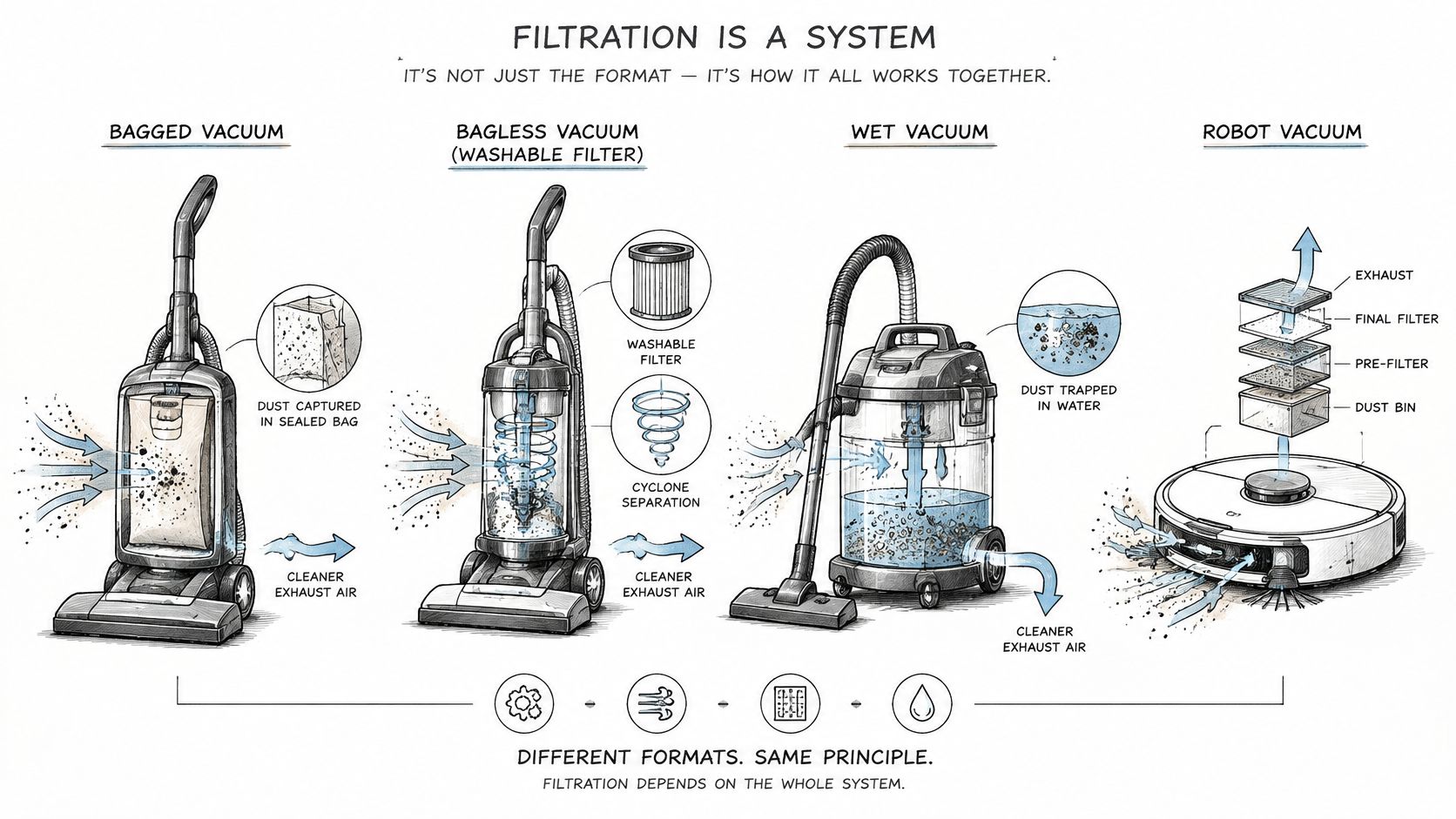
A Building and Environment study compared four vacuum types, a washable-filter bagless machine, a bagged machine, a wet vacuum and a robot with a HEPA filter, and found significant differences in airborne particle mass and number; average indoor PM10 concentrations increased 1.61 ± 0.636 times with the bagged machine and 1.48 ± 0.323 times with the wet machine.
Those results concern the tested machines and conditions. They don't establish that every bagged vacuum increases particles by the same amount, or provide a universal ranking of collection formats. The washable-filter bagless machine was a separate emissions category, another reason not to collapse the findings into a bagged-versus-bagless slogan.
Separate operating emissions from disposal exposure
An earlier study involving homes of 11 atopic asthmatic subjects, indexed in the EPA's research database, found no significant difference in total dust weight or airborne house-dust-mite allergen between the conventional bag types tested, while the filter vacuums generally produced lower airborne allergen concentrations.
Bag construction also deserves scrutiny. Allergen testing identified poor performance from single-layer bags and manufacturer-to-manufacturer differences among multilayer microfiltration bags. Independent emptying tests generally favoured bagged machines for limiting dust release, but HEPA labelling alone didn't guarantee low allergen emissions.
These findings support a narrower conclusion than “bagged is best for allergies.” A well-sealed, multistage bagless machine can outperform a poorly sealed bagged machine during operation. Contained bag disposal may still be preferable when the owner must remove collected dust.
Rank the complete dust-control system
For asthma, pets or severe allergies, the buying order should be:
- Sealed construction: Look for evidence about the complete airflow path, not just a filter fitted somewhere inside it.
- Filter performance: Identify the exhaust filter and its maintenance requirements.
- Independent emissions evidence: Prefer results for the exact model over broad brand or format claims.
- Disposal procedure: Check how the closure works before the dust leaves the machine.
The air purifier comparison addresses a separate household purchase. An air purifier shouldn't be treated as permission to accept avoidable leakage or a disposal routine that exposes an allergy-sensitive person to dust.
How Suction and Upkeep Change as Each Fills
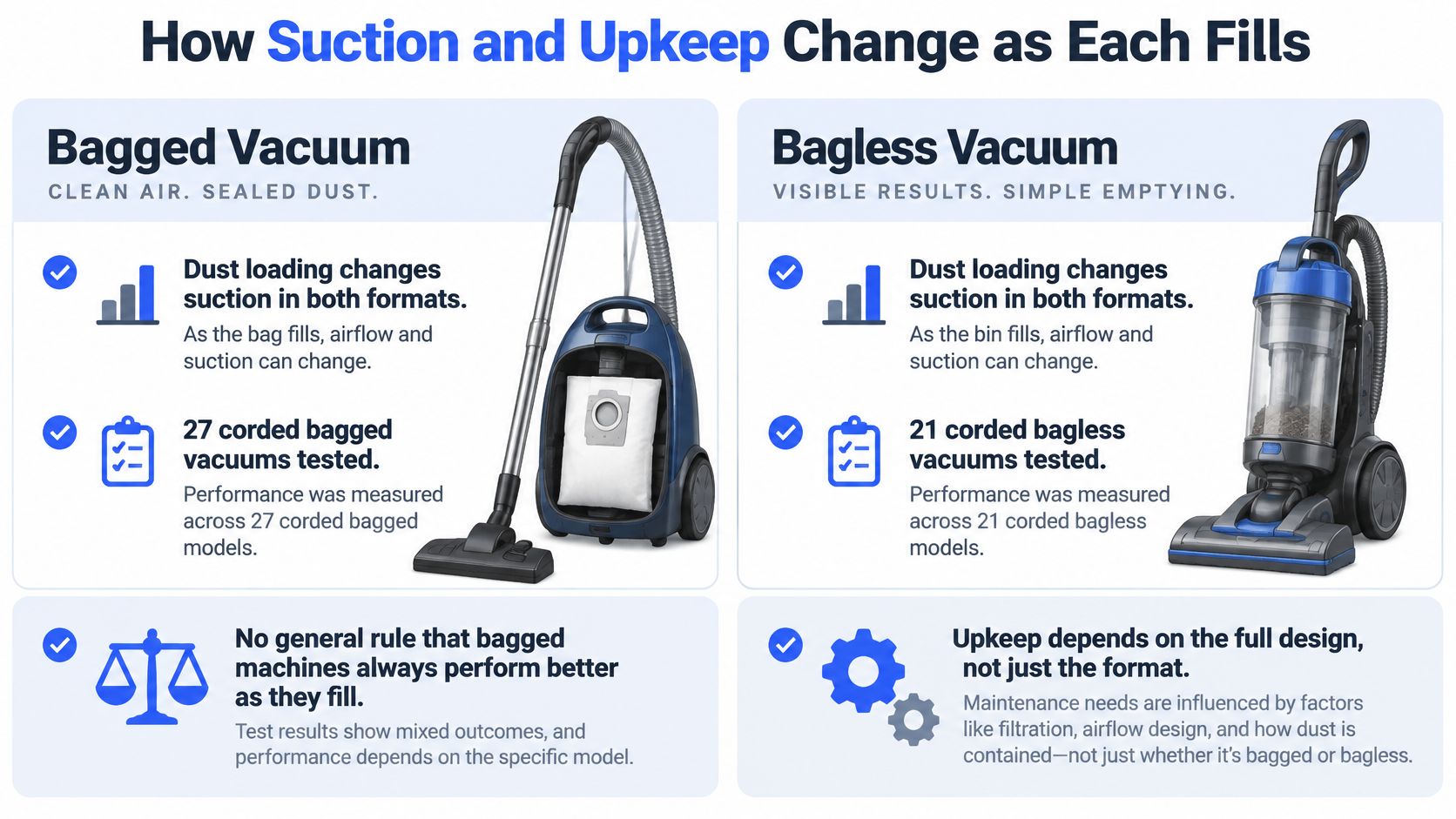
Dust loading affects both formats. The evidence doesn't support a blanket claim that bagged vacuums clog or lose performance faster.
A European vacuum-cleaner technical review examined 27 corded bagged and 21 corded bagless vacuums, found broadly similar responses to dust loading, and included a component example in which suction fell from 242 W to 227 W, a 6.4% reduction; it also identified approximately 18 to 25 kPa minimum pressure drop and at least 8.5 L/s airflow with a full bag as engineering reference points.
Those engineering figures aren't a consumer cleaning score. Floor pickup under comparable conditions remains more useful than an isolated pressure or airflow specification.
Filter condition changes the comparison
The European Commission's vacuum-cleaner guidance describes typical HEPA-filter pressure drop increasing from about 250 to 300 pascals when empty to 500 to 600 pascals when full, and records a six-month replacement recommendation in the guidance reviewed.
A loaded filter creates more resistance to airflow. In a bagless cyclone design, the filter can carry more of the remaining separation burden, whereas a bag performs part of that work before air reaches the final filter. That helps explain why avoiding bag changes doesn't remove maintenance.
Follow a routine the machine actually supports
- Empty or replace before the fill line. Don't compress extra debris into the container to postpone the job.
- Check the closure. Seat the bag collar correctly or close the bin lid fully, and remove trapped debris from the sealing surface.
- Clean filters only as permitted. Tap or wash them at the intervals specified in the manual. A filter isn't washable merely because it can be removed.
- Use the model's replacement schedule. The reviewed interval isn't a universal rule. Replace damaged filters and let washed components dry completely before refitting.
- Compare loaded and unloaded pickup. Look for testing that repeats cleaning tasks after dust has accumulated, rather than relying only on an empty-machine result.
A useful review should distinguish a machine that retains pickup from one that merely advertises strong initial suction. Measured cleaning under load beats the bag label, because it evaluates the interaction between the dust container, filters, airflow and cleaning head.
The Real Running Cost Beyond the Purchase Price
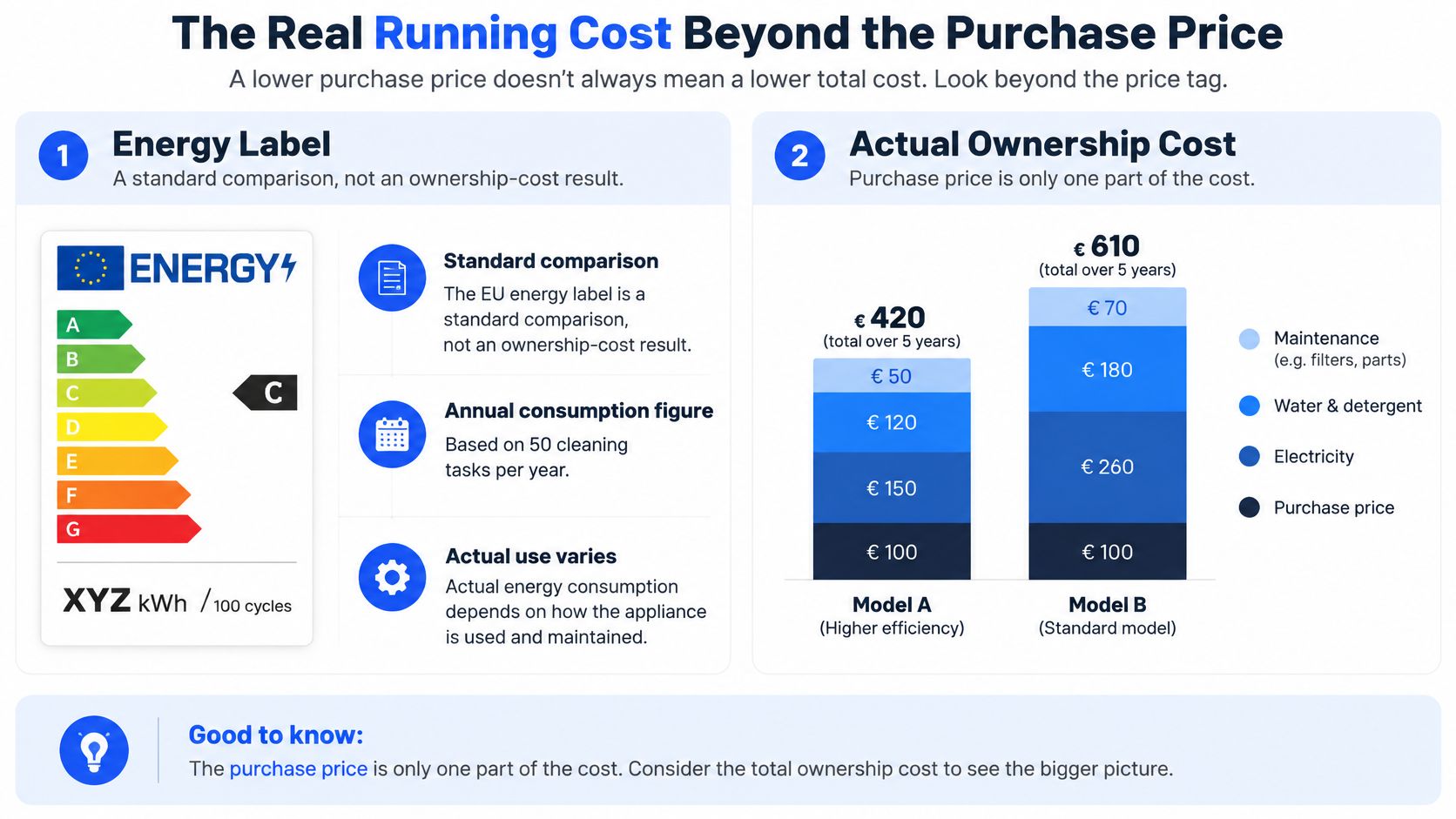
Compare ownership cost, not just the missing bag bill. Start with the purchase price, add compatible consumables over the same ownership period, and keep electricity and maintenance time visible.
The historical EU label's indicative annual energy-consumption calculation uses 50 cleaning tasks, while the governing regulation states that actual consumption depends on how the appliance is used. That standardised comparison doesn't include bags, filter replacements or the owner's cleaning time.
Ownership cost items for bagged and bagless vacuums
| Cost item | Bagged vacuum | Bagless vacuum | How to measure it |
|---|---|---|---|
| Disposable bags | Recurring, a fresh bag per replacement cycle | None | Count annual changes and multiply by the seller's pack price divided by bags per pack |
| Filter replacement | Exhaust filter, potentially changed less often | Washable or replacement filters, potentially cleaned more often | Check the manual's interval and seller's replacement price |
| Electricity | Historical EU label uses the standard task basis | Same comparison basis | Compare equivalent label values; expect household use to differ |
| Emptying time and mess | Close the bag and dispose of it | Empty the bin and wash permitted parts | Record time spent and whether disposal releases unacceptable dust |
| Purchase price | Current price for the exact bagged model | Current price for the exact bagless model | Take the current figure from the seller page |
Build a calculation from real replacements
A household can work through the calculation without assuming market-average prices. For a bagged candidate, divide the compatible pack price by its bag count, then multiply that unit cost by expected annual bag changes. Add filter purchases over the intended ownership period.
For the bagless candidate, remove the bag expense but retain replacement filters. A washable filter shouldn't be entered as permanently free unless the documentation supports that assumption.
The repeatable calculation is:
Ownership cost = purchase price + bags + replacement filters + electricity + other required consumables.
As a worked comparison, suppose the bagged candidate costs less to buy but requires recurring bag purchases. Subtract its purchase-price advantage from its additional consumable spending over the chosen period. If consumables exceed that advantage, the bagless candidate becomes cheaper on those inputs, provided other costs are equivalent.
Comredix quotes prices in its rankings from the seller. Each quoted price should be confirmed on that seller's page before calculating totals, including the precise replacement-part code and pack contents.
Keep waste and labour separate
Bagged systems create recurring bag waste. Bagless systems avoid that item but still involve filters, washing and dust handling. Neither fact alone establishes the smaller environmental footprint.
Maintenance time is best recorded separately unless the household deliberately assigns it a monetary value. The final comparison should show cash ownership cost plus the upkeep commitment, using the same period and cleaning assumptions for both candidates.
Which Format Fits Which Home
The household's least tolerable maintenance task should guide the shortlist. The evidence doesn't identify a universal winner for apartment residents, pet owners or frequent cleaners. It does show which questions each household should resolve.
A small apartment with light use
Start with bagless when avoiding bag purchases is the priority. A modest dust load can make reusable-bin ownership manageable, provided the owner has somewhere suitable to empty it and can access the filter easily.
Light use doesn't guarantee a long filter life or prove that bagless is cheaper. Check the actual replacement instructions rather than assuming a small home removes those costs. A compact bagged machine remains a reasonable alternative for someone who dislikes handling loose dust.
A pet household
Judge hair handling and disposal before choosing the format. Check whether hair catches around the bin's internal shroud, whether the opening is easy to reach, and whether the bag closes before removal.
Pet ownership alone doesn't settle the comparison. A bin that needs manual clearing may be unacceptable to one owner, while another may prefer it to frequent bag purchases. Cleaning-head suitability and access for removing tangled hair also deserve attention, independently of dust collection.
The format matters less than the sealing, the filter and how often the machine is emptied.
An allergy-sensitive home
Prioritise documented containment and a disposal method the affected person can tolerate. A bagged shortlist makes sense when avoiding direct contact with collected dust is the main concern, but a bag isn't sufficient evidence of clean exhaust air.
Where comparable emissions results aren't available, that uncertainty should remain explicit. A product description cannot establish which candidate will produce the lowest exposure in a particular home.
A large home or frequent professional use
Compare replacement frequency with serviceability. Heavy cleaning makes access to bags, filters and the dust compartment more consequential. Check consumable availability before choosing a machine whose upkeep relies on an obscure replacement part.
Professional suitability also requires checking the manufacturer's intended use, not assuming a domestic model can support a demanding schedule. The collection format doesn't answer that question.
For households considering automation, the robot vacuum comparison offers another shortlist. Evaluate the robot's onboard collection and its dock separately, because automated transfer doesn't eliminate eventual disposal or maintenance.
Check These Specs Before You Buy
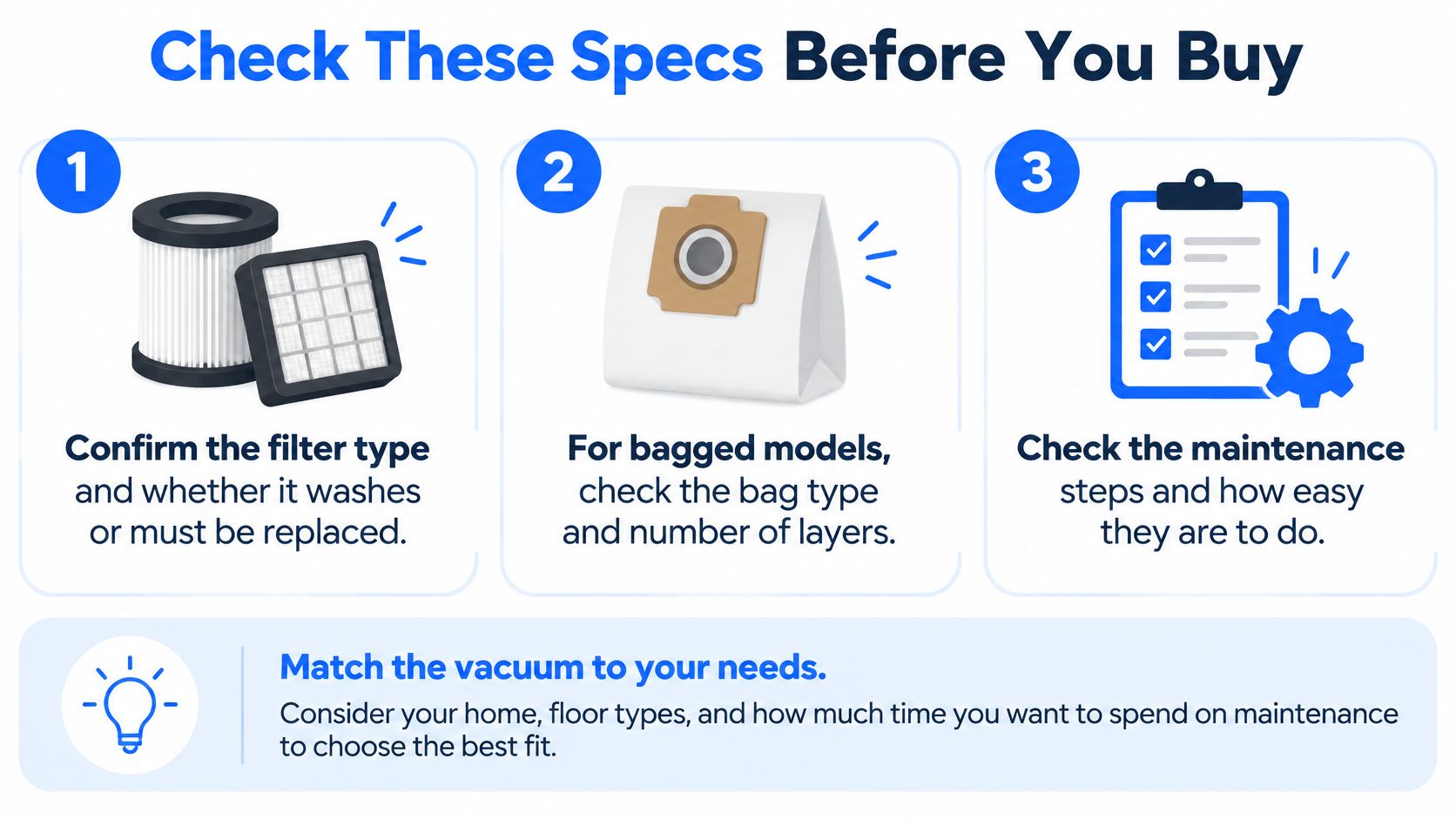
- Identify the filter. Confirm its type and whether the manual permits washing or requires replacement.
- Inspect the bag specification. For bagged models, check compatible bag codes, construction and layers.
- Verify containment claims. Seek independent backing for sealing and filtration, not just the word HEPA.
- Look for loaded pickup results. Compare cleaning performance before and after dust loading, not an unloaded suction headline.
- Price the replacements. Check current compatible bag and filter prices on the seller's own page.
- Build the shortlist. Use Comredix's vacuum cleaner ranking to compare documented specifications and seller-quoted prices, then confirm each figure before purchase.
Read the manual before placing the order
The maintenance pages reveal details that a product headline can hide. Check how the filter comes out, which seals need inspection, whether the bin separates for cleaning, and what must dry before the machine can operate again.
For a bagged candidate, inspect the fitting procedure as well as the removal procedure. A compatible bag must seat correctly; a cheap pack with an uncertain fit isn't a useful saving. For bagless, check whether routine cleaning requires reaching into a narrow container or dismantling several components.
- Check part identity: Match the full model designation to the replacement bag or filter.
- Check access: Look for clear instructions and diagrams showing each routine maintenance task.
- Check evidence gaps: Treat missing loaded-pickup or emissions testing as unknown, not as proof of good performance.
Separate documentation from testing
Documented specifications establish what a manufacturer says a machine contains and how it should be maintained. Independent testing addresses how it performs under the stated conditions. Neither should be presented as a substitute for the other.
A shopper can still make a sensible choice without a complete laboratory record. The important step is to avoid filling gaps with assumptions about bags, cyclones or a familiar brand name.
The deciding question isn't which format sounds more advanced. It's which exact machine combines suitable cleaning evidence, acceptable disposal and obtainable consumables. Choose the format whose upkeep and replacement requirements the household will maintain.
Comredix is an independent reviews publication offering comparisons based on documented features and seller-quoted prices. Visit Comredix to shortlist vacuum cleaners, compare their maintenance requirements and check the consumables behind the purchase price.
Spotted an error in this guide? Email editorial@comredix.com