Studio note · General
Credit Card Rates Compare: APR Ranges and Real Costs
Use this guide to see how credit card rates compare across APR types, fees and offers, with 2026 ranges and a $1,000 cost example.
- Updated
- November 19, 2026
- Reading
- 14 min
The average rate on credit-card accounts assessed interest reached 22.80% in November 2024, against 15.77% in November 1994, a rise of 7.03 percentage points and roughly 45% over three decades, according to the Federal Reserve's historical Consumer Credit series. Rates sat in the mid-teens through the late 1990s before climbing across the cycles that followed.
That number is the most repeated figure in card writing and it settles almost nothing. It averages every account carrying a balance across the commercial-banking card market. It isn't the rate on any card a reader can apply for, and it isn't the rate any borrower signed.
Knowing how credit card rates compare starts with separating three kinds of figure. A portfolio average describes accounts that revolve. An advertised range describes what an issuer will offer a new applicant. An observed account rate describes what one borrower received. Pages that blend the three produce a ranking of sentences rather than of costs, and the dollar gap between them is where the decision actually sits.
Table of Contents
- Current Credit Card Rate Ranges by Card Type
- The APR Types Behind Every Quoted Rate
- How Interest Accrues and What It Costs
- Balance Transfer and Intro Offers Compared
- Store Cards and Issuer Size Price Gaps
- Choose the Card by How You Repay
Current Credit Card Rate Ranges by Card Type
Most credit cards quote purchase rates in the low-to-high 20s, and cards tied to a single retailer sit higher still.
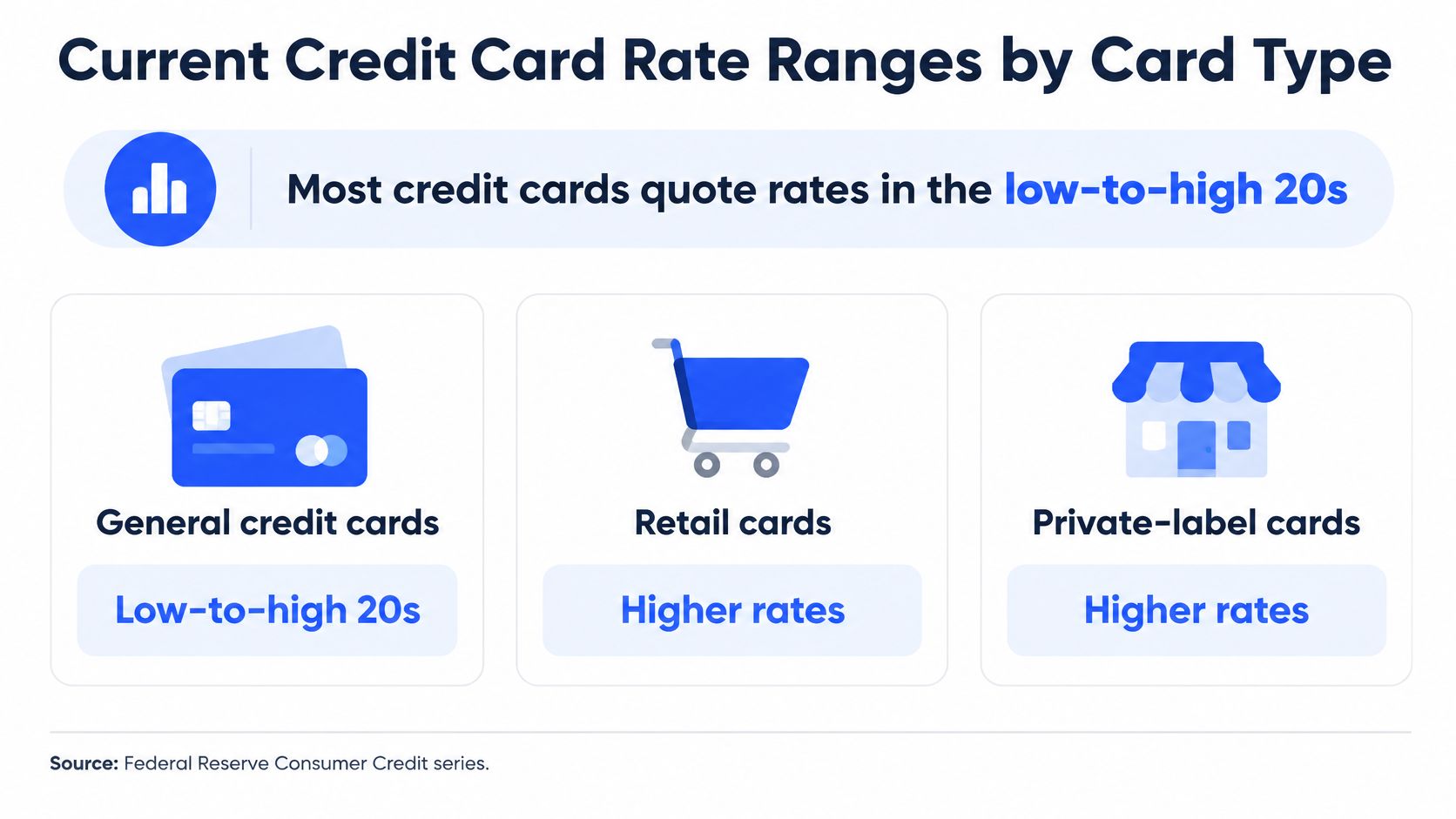
The benchmarks below come from three publishers measuring three different things. Read the period and the publisher beside each figure before using it in any comparison.
| Card category | Rate benchmark | Period | Source |
|---|---|---|---|
| All accounts assessed interest | 21.5% | Q1 2026 | Federal Reserve series |
| Accounts assessed interest, monthly series | 22.80% | November 2024 | Federal Reserve series |
| General-purpose cards | 25.2% | 2024 | CFPB 2025 market report |
| Private-label cards | 31.3% | 2024 | CFPB 2025 market report |
| Retail cards | 30.14% | 2025 | Bankrate 2025 survey |
Start at the top. The 21.5% recorded for accounts assessed interest in the first quarter of 2026, one of the figures collected in Financer's credit-card debt statistics, covers balances that were charged interest. The same collection reports Bankrate's 2025 survey finding an average retail-card APR of 30.14%, with store-only cards averaging 31.64%, and notes that 23 of 110 surveyed cards raised their APR during the prior 12 months even as the Federal Reserve cut rates.
Why the Benchmarks Don't Line Up
The CFPB's 2025 Consumer Credit Card Market Report, covering 2024 conditions, put the average APR at 25.2% for general-purpose cards and 31.3% for private-label cards, and described both as the highest levels since at least 2015. That 6.1-point gap makes the average private-label rate roughly 24% higher than the general-purpose rate when measured against 25.2%.
Set 21.5%, 22.80%, 25.2%, 30.14% and 31.3% side by side and the temptation is to average them into one market rate. They don't describe the same population. A portfolio series on accounts assessed interest leaves out every account that pays in full and never incurs a charge, so it runs below what a new applicant is quoted. A survey of advertised retail rates counts offers, not accounts. The CFPB figures average across card categories with very different underwriting.
A portfolio average, an advertised rate and one applicant's quoted APR are three separate measurements. Only one of them can describe your account.
That distinction changes the arithmetic. A card quoted at the low end of its advertised range and a card quoted at the top can be the same product, priced against two different credit profiles. Comparing the printed ranges as if they were prices is the most common error in this category.
Three Questions Before Comparing Any Two Cards
- Which category is the card in? General-purpose, retail, private-label, secured and student cards cluster at different rate levels before creditworthiness enters the picture at all.
- Which APR is meant? Purchase, balance transfer, cash advance and penalty rates can differ by many points on the same account, so a quote that doesn't name the type can't be used.
- Is this an offer or an observed rate? Offer rates describe what issuers advertise to new applicants. Observed rates describe what existing accounts pay. They move at different speeds and in different directions.
Before credit card rates compare in any useful way, those three answers have to be fixed. Otherwise the comparison is between headlines, not between costs.
The APR Types Behind Every Quoted Rate
The rate on a card's landing page is one of at least four the account can carry. The FDIC's consumer resource on credit cards defines APR as the annual cost of a card including interest and fees, and notes specifically that cards may set separate APRs for purchases, balance transfers and cash advances. The same page lists annual, balance-transfer, cash-advance, foreign-transaction, late-payment and returned-payment fees as separate comparison points.
Purchase APR applies to everyday spending and is the number almost every comparison site quotes. It's the only one of the four that a grace period can neutralize.
Balance transfer APR applies to debt moved from another issuer. It's often the same headline rate as the purchase APR, but the promotional version is where the marketing lives and the post-promotional version is where the cost lives.
Cash advance APR applies to cash withdrawn against the card and to certain transaction types an issuer classifies that way. It typically sits above the purchase rate, and a grace period rarely covers it, which is why a card marketed on a low purchase rate can be expensive for a borrower who uses an ATM.
Penalty APR applies after a late or returned payment. It's usually the highest rate the account can carry, and it stays until the issuer's conditions for removing it are met.
Most of these rates are variable, tied to a benchmark index plus a margin, so they reprice when the index moves. A minority are fixed, which in practice means they hold until the issuer changes terms under the notice provisions in the agreement. Either way, the rate printed at approval isn't guaranteed for the life of the balance.
APR isn't a card-only concept, and the way it's built differs by product. The explainer on APR on student loans shows how origination fees fold into an installment APR, which is the piece a revolving card handles through separate fee lines instead.
The checklist that works: find the pricing table in the agreement, write down every APR and what triggers it, add the fees that recur, and mark which balances the grace period covers.
Applied properly, that checklist settles most card comparisons in ten minutes. The test is simple. A card with the lowest purchase APR can still be the costliest option for a borrower who takes a cash advance or misses a payment, because the low headline number sits on the one rate that borrower never pays.
How Interest Accrues and What It Costs
An APR turns into a charge through a daily rate applied to a balance that moves during the month. The CFPB's credit-card contract definitions describe the mechanics: the issuer applies a daily periodic rate to the amount owed each day, then adds the daily interest across the billing cycle. The daily rate is usually the APR divided by 365, though some issuers divide by 360, and that alone makes two identical APRs slightly different in cost.
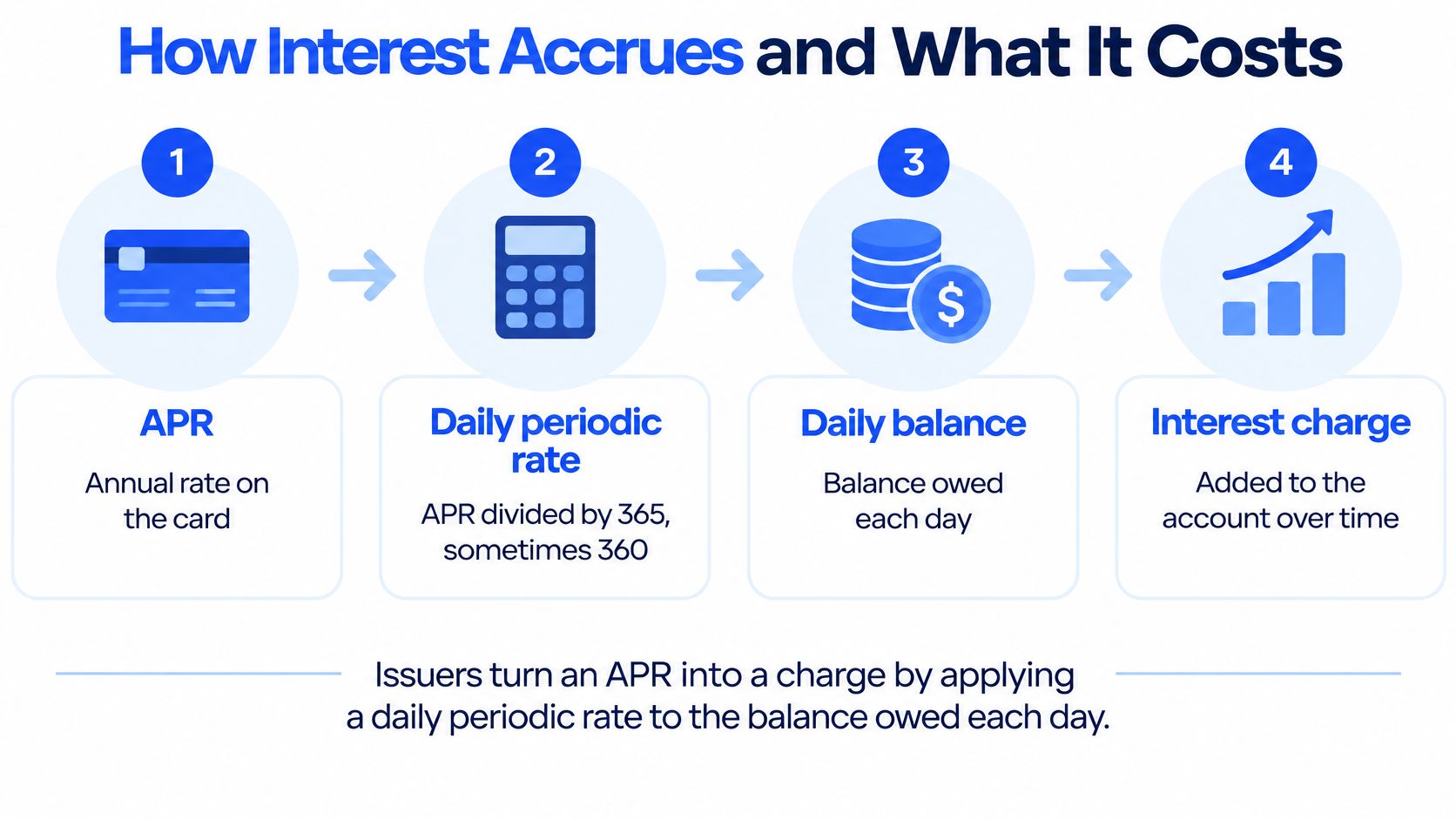
From an APR to a Daily Charge
- Divide the APR by 365. Take the stated rate and divide it, using the day count the issuer uses.
- Multiply that daily rate by the balance owed each day. A payment that clears mid-cycle lowers every day that follows it, which is why payment timing matters as much as the rate.
- Add the daily amounts across the billing cycle. The total is the interest charge for that statement period.
- Clear the full statement balance by the due date to keep the grace period on purchases. Partial payments forfeit it on the unpaid portion.
The grace period is the interval between the end of a billing cycle and the payment due date. The CFPB's key-terms guide explains that interest on purchases can be avoided when the balance is paid in full by that date. Card agreements decide which balances qualify, and a balance moved from another issuer or drawn as cash usually isn't among them.
| Repayment pattern | Cost on $1,000 | Basis |
|---|---|---|
| Paid in full by due date | $0 on purchases | Grace period applies when the statement balance is cleared |
| Carried one year at 25.2% | $252 | Simple interest, ignores compounding |
| Carried one year at 31.3% | $313 | Simple interest, a $61 difference from 25.2% |
The two carried-balance figures are the CFPB's own illustration of a 25.2% and a 31.3% APR on $1,000 held for a full year. They're deliberately simple, and that's the point. The gap between the two card categories is only $61 a year on a four-figure balance, which is why a rate difference between categories is rarely the whole story about a card.
Where the Simple Figure Breaks
Real statements don't hold a balance steady for twelve months. Interest compounds when it's added to the principal instead of paid, so the second month charges interest on the first month's charge. New purchases made after the statement date enter the average daily balance and start accruing immediately if the previous balance wasn't cleared.
- Compounding raises the effective cost above the simple figure, and the effect grows with the balance.
- Cycle length changes the total, since a 31-day cycle charges one more day than a 30-day cycle.
- Mid-cycle payments reduce the charge, and the earlier in the cycle they land, the more they save.
- Day-count convention separates two cards with the same stated rate by a small but real margin.
A late or returned payment adds a fee on top of the interest, and the same logic of small recurring charges building into a large annual cost applies across account fees generally. The Comredix data page on the average overdraft fee tracks that figure in the same sourced way.
Practical rule: run the calculation on the balance you expect to carry, not the balance in the offer's example, and use the rate you're likely to be assigned rather than the lowest rate in the range.
Balance Transfer and Intro Offers Compared
The introductory rate isn't the cost of a balance transfer. A Visa card listing shows why: a 3% balance-transfer fee for transfers made within 120 days, a later fee of up to 5% with a $5 minimum, and variable post-introduction APRs of 18.74%, 24.74% or 28.74%. Four separate prices sit behind one headline offer.
| Offer element | Figure in listing | What to check |
|---|---|---|
| Transfer fee within 120 days | 3% | $30 on a $1,000 transfer |
| Transfer fee after the window | Up to 5% | $50 on a $1,000 transfer, so move the balance inside the window |
| Minimum transfer fee | $5 | Takes over on transfers under about $167 |
| Regular APR after introduction | 18.74%, 24.74% or 28.74% | Assigned by approval tier, so the printed figure may not be the applied rate |
| Promotional window | 120 days | Plan repayment to finish inside it |
The fee math is the part readers skip. Three percent of $1,000 is $30, and five percent is $50. The minimum governs small transfers, which means a $100 transfer still costs $5, an effective 5% regardless of the stated percentage.
Then comes the post-promotional rate. A transferred balance starts accruing interest from the transfer date and the promotional window is the only stretch it gets free, so the useful question is what happens to whatever remains when the window closes. Borrowers approved at the 28.74% tier are looking at a very different four months than borrowers approved at 18.74%, and the offer page rarely confirms which tier applies before approval.
Divide the transfer fee by the number of promotional months. If that monthly figure is below the interest the same balance would accrue at the regular APR, the transfer earns its fee.
Run that test. Take $1,000 and the 3% fee of $30 spread across the roughly four months of a 120-day window, which is about $7.50 a month. The same $1,000 at 24.74% accrues about $20 a month in interest before any payment is made. The transfer is clearly cheaper if the balance clears inside the window, and clearly worse if it doesn't, because the fee gets added to a balance that then pays the regular rate.
Two rules follow. Set the payoff date inside the promotional window before submitting the transfer, not after. And compare the fee plus post-promotion interest against the interest the current card would charge over the same period, which is the only comparison that reflects what the transfer costs.
Store Cards and Issuer Size Price Gaps
Store cards look cheaper than they are, because the discount is visible at the register and the rate isn't. In December 2024, private-label cards for the largest retailers had an average APR of 32.66% for new accounts, according to the CFPB.
Issuer size adds a second layer. The CFPB reported in February 2024 that the 25 largest credit-card issuers charged interest rates 8 to 10 percentage points higher than small and medium-sized banks and credit unions.
Translate that into cash. On a $1,000 balance held for a year at simple interest, an 8 to 10 point gap comes to roughly $80 to $100. That's the size of the price difference between shopping at a large issuer by default and checking a credit union or a community bank, before any rewards are counted.
What to Check on a Store Card
Compare two rates, not one. Pull the purchase APR and the penalty APR from the card's disclosure and set both against a general-purpose card the borrower could qualify for. A store card with a competitive purchase rate and an aggressive penalty rate is still an expensive card for anyone who might miss a due date.
Price the discount against the interest. Work out the dollar value of the discount on the purchases the borrower expects to make, then compare it with the interest on the balance likely to be carried. A 5% discount on $200 of purchases is $10 once. Interest at around 30% on a $500 balance runs to about $150 across a year.
Confirm the discount's scope. Retailer discounts frequently apply to certain categories, certain promotional periods or certain card tiers rather than every purchase. Read the terms for what's excluded before treating the discount as a general saving.
The pattern is consistent: a store card suits a shopper who clears the balance every month and uses the discount. A carried balance at roughly 30% erodes the saving within a couple of statements and keeps eroding it.
A 5% discount taken at the register is worth less than a 30% rate charged on the balance that carries it.
These are category and issuer patterns, not quotes. Any individual rate comes from the card's own disclosure, and the disclosure is what governs after approval.
Choose the Card by How You Repay
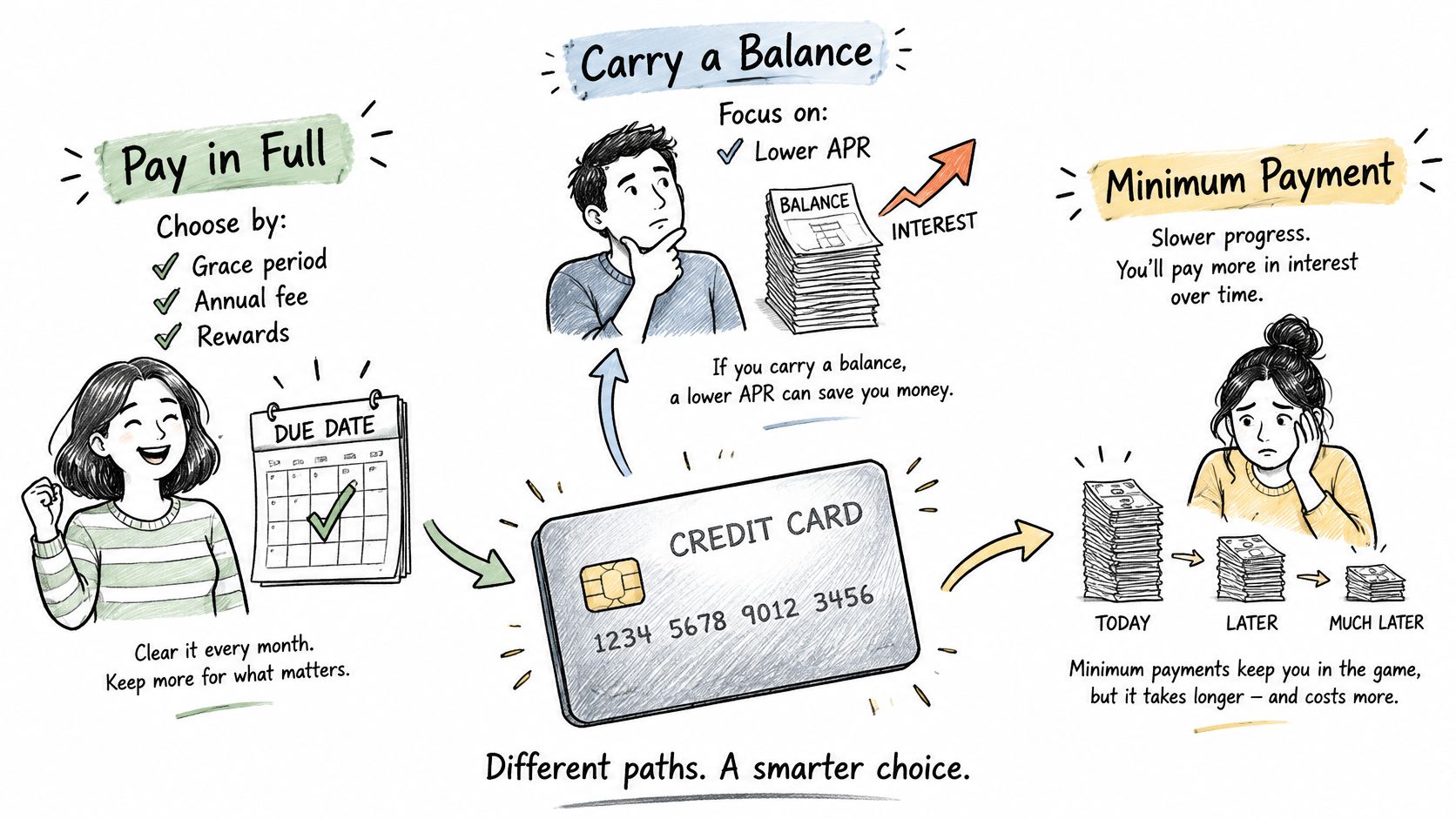
A card choice is only as good as the repayment pattern it's matched to. Four patterns cover most borrowers, and each one points to a different set of deciding features.
Pays in full every month. The purchase APR matters least here, because a cleared statement balance never accrues interest on purchases. Choose based on grace period length, annual fee and rewards, and confirm the grace period applies to the transaction types the borrower uses. A richer rewards card with a higher APR can be the better card for this borrower, and often is.
Carries a balance for a few months. Lowest purchase APR wins, with the lowest penalty APR as the tiebreaker. Rewards rarely cover the interest on a carried balance at these rate levels, so a flat-rate card at the low end of its range beats a points card at the high end.
Moves existing debt. Set the payoff date inside the transfer window and reject any transfer where the fee plus post-promotion interest exceeds the interest the current card would charge. At 3%, a $1,000 transfer costs $30, so the fee is rarely the deciding factor and the post-promotion rate usually is.
High utilization or late-payment risk. Approval tier and penalty terms outrank the advertised rate, because the advertised rate may not be available. The CFPB's credit-linked consumers report, published in April 2026, shows how far apart observed groups sit: average credit-card utilization of 27% in one group against 41% in another, and any 60-day delinquency history for 8% against 18%. A borrower in the higher-utilization group may be denied the lowest advertised tier outright or assigned the top of the range.
That last point reframes the whole exercise. A modest difference in advertised APR is not the main variable for a borrower carrying balances at 41% utilization, because qualification and repayment behavior decide the rate that gets applied.
Three Steps Before Applying
- Estimate the monthly balance carried. Not the credit limit, not the headline purchase figure. The average balance expected to sit on the account after each statement.
- Pull the APR table from every candidate agreement. Purchase, balance transfer, cash advance and penalty rates, plus the annual and transaction fees that recur.
- Calculate the one-year cost on that balance for each card. Multiply by each APR, add the fees that would apply within the year, and pick the lower total.
The credit card debt statistics page on Comredix collects the balance and delinquency figures behind these patterns, which is useful when setting the estimate in step one.
Comredix applies one published scoring method across its rankings, links every figure to the publisher that reported it, and copies prices from sellers' pages on the date shown. That approach helps here because rate comparisons age quickly: issuers reprice variable APRs when the benchmark index moves, and promotional terms change with each product cycle.
Why the Agreement Still Wins
Every figure in this guide describes a benchmark, a survey average or a category pattern. None of them is a quote. The card's current agreement, pulled on the day of the application, remains the only document that states the rates and fees a specific borrower will be charged.
Check three things on that document before signing: the purchase APR range and where the applicant's profile is likely to land in it, the penalty APR and what triggers it, and the fee schedule for the transactions the borrower makes. If any of the three is missing from the offer page, the agreement has it.
That's the whole discipline behind a useful comparison. Separate the offer rate from the portfolio average, price the specific balance over a full year, and let the repayment pattern decide which number matters. The card with the lowest headline APR is the cheapest card only for the borrower whose behavior matches the assumption behind that headline.
Comredix ranks cards, banking products and payment tools on one published scoring method, with every quoted figure linked to the publisher that reported it and prices copied from seller pages on the date shown. Its data pages collect the credit card debt, rate and delinquency figures used throughout this guide, so a comparison can be checked line by line rather than taken on trust. Visit Comredix to see the current rankings, the underlying statistics and the sources behind each number.
Spotted an error in this guide? Email editorial@comredix.com