Studio note · General
APR on Student Loans: 2026 Rates and How to Compare
APR on student loans explained with 2026 federal fixed rates, origination fees, capitalization and how to compare offers by total repayment cost.
- Updated
- November 16, 2026
- Reading
- 14 min
The 2025-26 undergraduate federal student loan interest rate is 6.39%, fixed for the life of each loan and set by its first-disbursement date. APR on student loans can be higher than the stated interest rate because mandatory fees also count toward the cost of credit.
The more useful question isn't which loan advertises the lowest percentage. It's which loan supplies the required funds at the lowest affordable total repayment cost. Fees reduce the money delivered, while unpaid interest can increase the balance eventually repaid.
The Comredix review desk separates those effects rather than treating a headline rate as a complete price. A sound comparison needs the correct loan date, the net proceeds, and a repayment schedule that accounts for interest accumulation.
Table of Contents
- Current Federal Student Loan APR by Loan Type
- What the APR Includes Beyond the Interest Rate
- How Capitalization Raises the Real Cost
- Federal and Private Student Loan APRs Compared
- Student Loan Interest Outside the United States
- Quick Reference to Student Loan Rate Terms
- Checking What an APR Quote Assumes
- Compare Two Offers by Total Cost
Current Federal Student Loan APR by Loan Type
Direct PLUS carried the highest of the three published federal rates for 2025-26, at 8.94%, against 7.94% for graduate Direct Unsubsidized and 6.39% for undergraduate Direct loans, according to the Department of Education rate schedule published by MOHELA. Each figure is a fixed interest rate set at first disbursement, so a fee-inclusive APR lands higher, and two quoted APRs only rank these loans correctly when both are calculated on the same disbursement and fee basis.
The same schedule lists both academic years side by side. The differences between rows reflect loan category, since federal rates are published per category rather than priced off each borrower's credit score.
Federal student loan fixed rates by academic year
| Loan type | 2024-25 | 2025-26 |
|---|---|---|
| Undergraduate Direct Subsidized and Unsubsidized | 6.53% | 6.39% |
| Graduate or professional Direct Unsubsidized | 8.08% | 7.94% |
| Direct PLUS for parents and graduate students | 9.08% | 8.94% |
Read down the 2025-26 column and the stated-rate spread between undergraduate and PLUS debt reaches 2.55 percentage points, before origination fees enter the math. Read across the undergraduate row and the same category repriced from 6.53% to 6.39% in a single year. Loans first disbursed on or after July 1, 2026 belong to the following award year and carry whatever rate that year's formula produced, so a comparison that ignores the disbursement window can assign the wrong rate to a real loan.
The date selects the rate
An academic-year label is shorthand for a first-disbursement window. It does not mean every outstanding federal loan receives that year's newly announced rate.
A borrower entering repayment can hold several loans with different fixed rates. Combining those balances in a spreadsheet without retaining each loan's rate distorts both interest estimates and decisions about extra payments.
The formula behind the annual reset is mechanical. The Federal Register annual notice describes it as the high yield on the 10-year Treasury note at the final auction before June 1, plus an add-on specific to each loan type, subject to statutory caps. The result prices loans newly disbursed in the coming award year; existing fixed-rate debt keeps its original rate for life.
The lookup runs in three steps:
- Find the first-disbursement date. Use the servicer's loan details or the borrower's Federal Student Aid account.
- Identify the category. Distinguish undergraduate Direct loans, graduate Direct Unsubsidized loans, and PLUS loans.
- Carry the matching rate into the comparison. Keep separate entries for loans with different disbursement windows.
Practical rule: A repayment start date is no substitute for a first-disbursement date.
What the APR Includes Beyond the Interest Rate
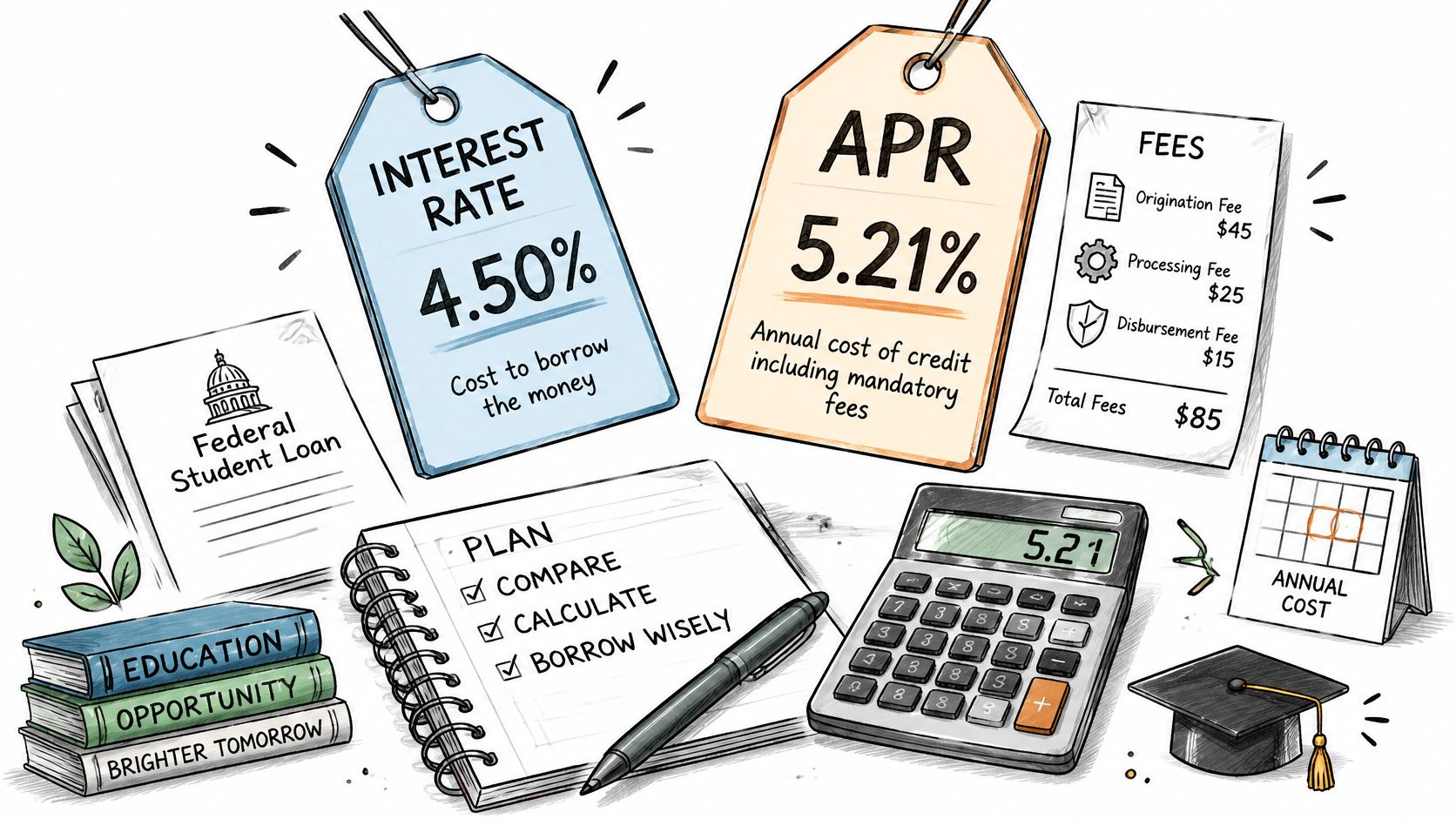
An origination fee means the borrower receives less money than the principal balance being financed. APR expresses the annual cost of credit, including interest and mandatory fees, so it shouldn't automatically be treated as identical to the interest rate.
Federal Student Aid's interest and fee schedule lists origination fees of 1.057% for Direct Subsidized and Unsubsidized Loans and 4.228% for PLUS Loans. Applied to a hypothetical $10,000 loan, those percentages produce the deductions and net proceeds below.
Origination fee effect on a $10,000 federal loan
| Loan type | Origination fee | Fee deducted | Net amount received |
|---|---|---|---|
| Direct Subsidized or Unsubsidized | 1.057% | $105.70 | $9,894.30 |
| Direct PLUS | 4.228% | $422.80 | $9,577.20 |
These are arithmetic illustrations using the published fees, not separate lender quotes. In either case, the borrower remains responsible for the full principal plus applicable interest even though the disbursement delivers less cash.
The illustration below separates the terms that belong on a loan-comparison worksheet.
Equal interest rates don't mean equal costs
For an interest-only baseline, $10,000 at 6.39% accrues approximately $639 over a full year, before repayment timing, capitalization, subsidies, or other mechanics change the result, using the rate published by Federal Student Aid.
Consider a separate hypothetical comparison: both offers charge that nominal rate, but one deducts a 4% fee and the other charges no origination fee. On a hypothetical $10,000 principal, the fee-charging offer supplies $9,600, while the no-fee offer supplies the full amount.
The fee-charging borrower doesn't receive a smaller repayment obligation to compensate. The same nominal principal supports less usable funding.
A loan comparison should hold the amount received constant, not merely the amount printed on the promissory note.
A higher advertised interest rate with no fee can therefore cost less than a lower rate with a substantial upfront charge. The outcome turns on the repayment term and payment dates, so the fee percentage should not be added to the annual interest rate. The lender's disclosed APR and a cash-flow calculation answer different parts of that question.
How Capitalization Raises the Real Cost
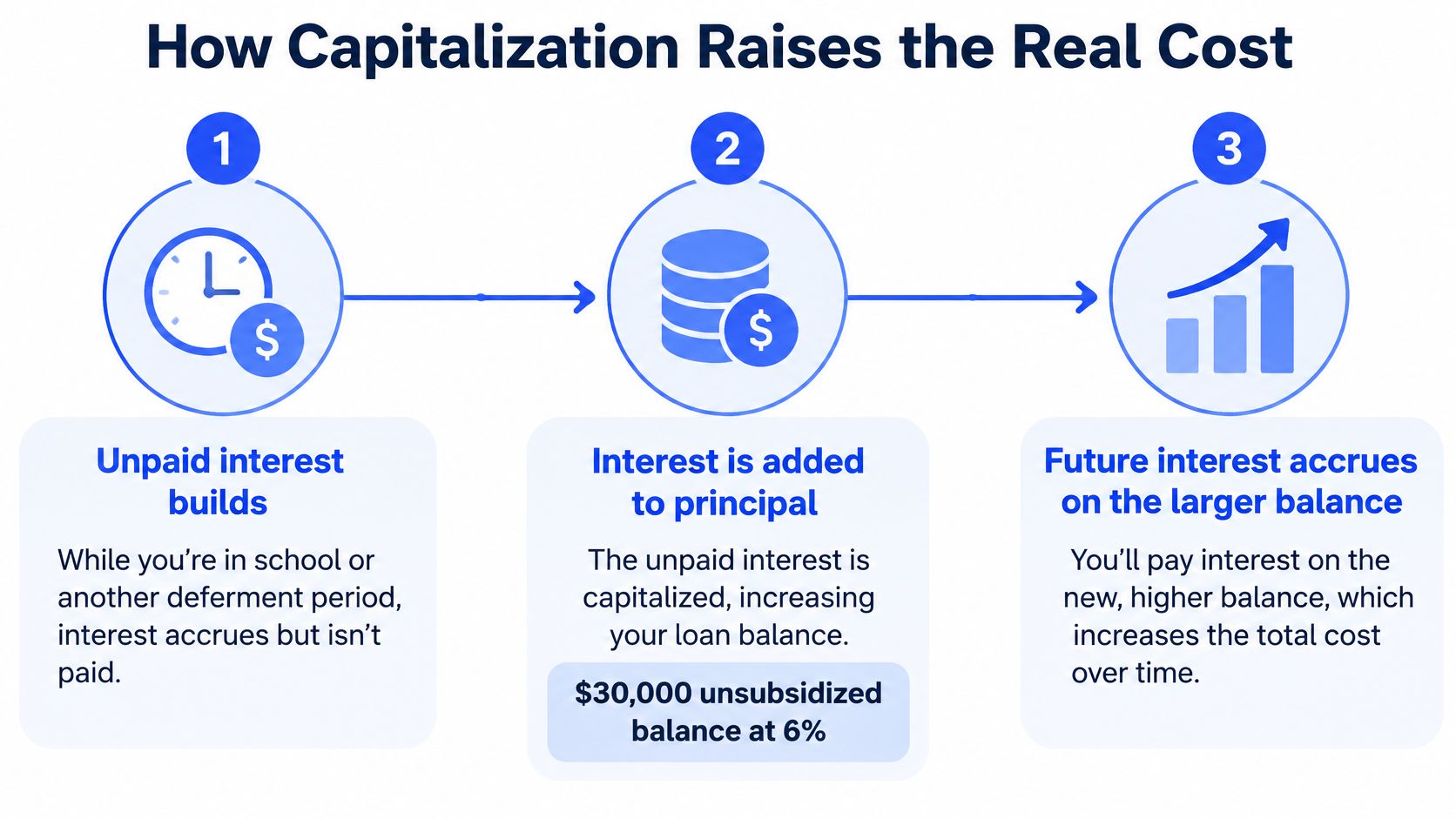
A quoted APR says nothing about when unpaid interest joins the balance. On a hypothetical $30,000 unsubsidized balance at 6%, one year of accrual produces $1,800 of interest. If that interest goes unpaid and the loan's rules trigger capitalization, the next interest calculation runs on $31,800.
The rate never changed. The base did.
Capitalization means adding unpaid interest to principal. It differs from accrual: interest can accumulate for months without becoming principal, and the loan's governing terms decide whether and when the accumulated amount joins the balance. Two borrowers at identical rates can owe different totals purely because their capitalization dates differ.
The timeline below shows that distinction.
Walking the balance forward
Assume no payments, an unchanged rate, and capitalization at each year-end. These assumptions illustrate the mechanism; they are not a claim that every federal loan capitalizes annually.
| Stage in the hypothetical scenario | Principal used for the next interest calculation |
|---|---|
| Original balance | $30,000 |
| After the first year's unpaid interest capitalizes | $31,800 |
| After another year's $1,908 interest capitalizes | $33,708 |
A borrower whose interest never capitalized would accrue $3,600 over the same two years: $1,800 each year on a constant $30,000 base. The capitalizing borrower accrues $3,708. The $108 gap is interest charged on the first year's interest, and it widens with every additional capitalization event.
For shorter periods, model interest as principal × annual rate × elapsed days ÷ 365. On the original balance that works out to roughly $4.93 per day; after the first capitalization, roughly $5.23 per day. A full 365-day year on the original balance returns the $1,800 figure above. The daily view exposes what the annual number hides: the cost of carrying the debt steps up immediately each time interest becomes principal.
Track balances, not just payments
A useful worksheet keeps three fields separate:
- Original principal: the amount initially borrowed.
- Accrued unpaid interest: interest that has accumulated but has not been added to principal.
- Post-capitalization principal: the balance the next interest calculation uses after a capitalization event.
Interest can accumulate during enrollment, grace periods, deferment, or forbearance. Accumulation alone does not guarantee capitalization follows. Each status carries its own treatment under the loan's terms and applicable federal rules, so a payment pause is never a single, uniform event.
The video below walks through the same process.
The meaningful sensitivity test holds the repayment term constant and compares total dollars repaid with and without the capitalization event. When comparing two offers, run both under identical disbursement dates and capitalization assumptions, because an APR quote can rank them wrongly if one loan capitalizes accrued interest earlier than the other. Voluntary payments need the same care: allocation rules determine whether a payment covers accrued interest first or reduces principal, and a payment that shrinks principal before capitalization lowers every later calculation.
Federal and Private Student Loan APRs Compared
Private advertised rates can sit below or far above federal rates, but the cheapest advertised private offer isn't a universal offer. In September 2025, WBUR's On Point reported published fixed-rate private student-loan APRs ranging from 3.54% to 16.74% across Sallie Mae, SoFi, College Ave, and Citizens Bank.
That range describes published offers at that time. It isn't a current quote, an approval guarantee, or proof that a particular borrower qualifies for the lower endpoint.
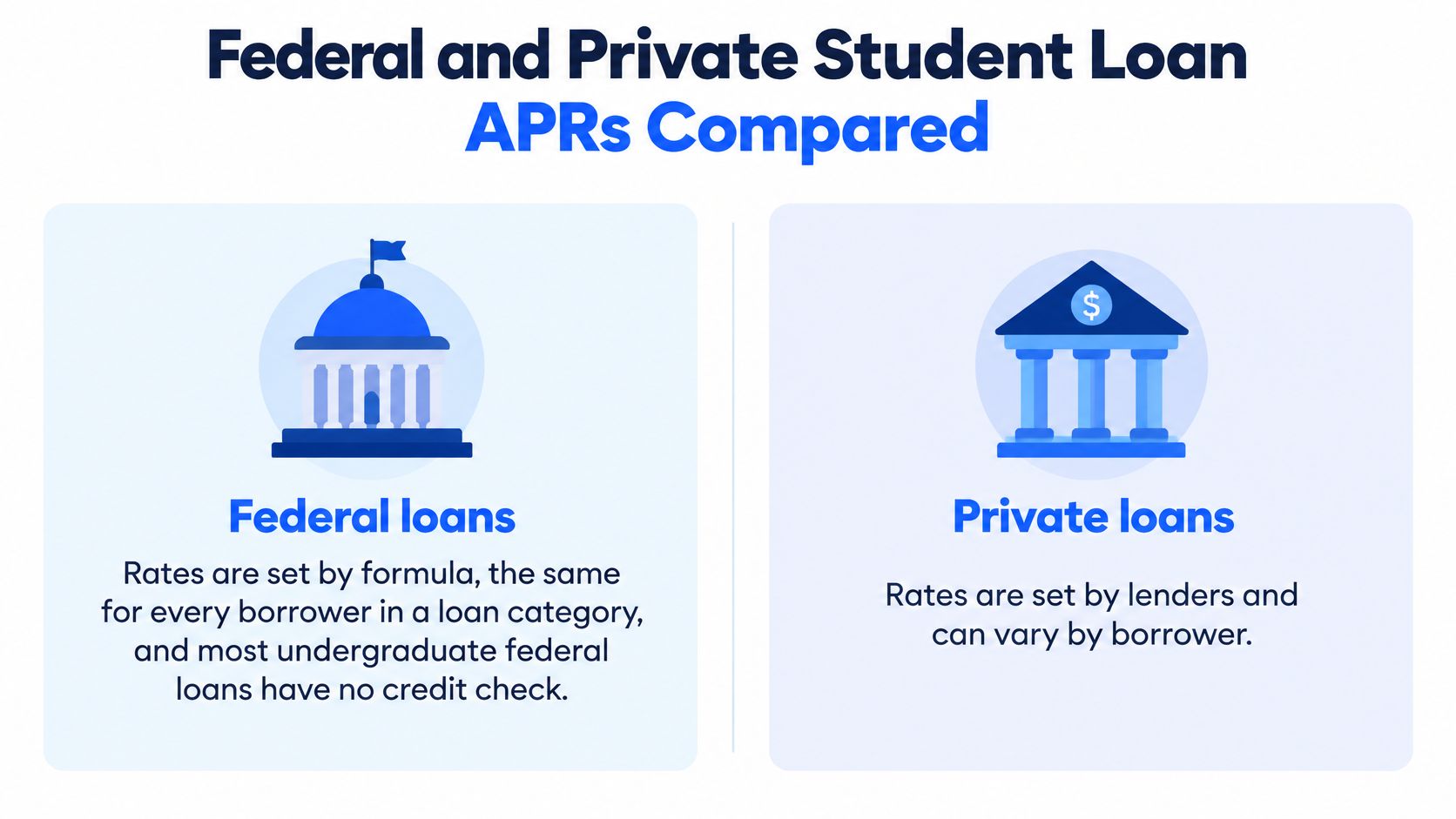
Federal rates follow a category-based formula. Private lenders evaluate the applicant, often alongside a cosigner, before determining the actual offer.
Federal and private student loan APRs compared
| Factor | Federal loans | Private loans |
|---|---|---|
| Undergraduate rate | Fixed by the applicable first-disbursement window | Personalized offer within the lender's available pricing |
| Who sets the rate | Federal formula each academic year | Individual lender after credit review |
| Origination fee | Published Direct and PLUS fee schedules | Check the lender's fee disclosure |
| Credit check | Not required for most undergraduate loans | Required; a cosigner may be needed |
| Rate type | Fixed for the life of each loan | Fixed or variable; variable rates can change |
The distinction between category-based and borrower-specific pricing is shown below.
Compare the contract, not the advertised minimum
A private variable rate generally uses an index plus a contractual margin. Its initial APR doesn't establish what the borrower will pay throughout repayment. The contract's adjustment rules matter alongside its starting percentage.
A fixed private offer avoids that particular uncertainty, but the borrower still needs to assess fees, payment timing, and relief provisions. A lender's brand name doesn't settle any of those questions.
Federal loans also provide access to federal deferment, forbearance, and qualifying income-driven repayment arrangements. Private lenders may offer hardship assistance, but borrowers shouldn't assume that assistance matches federal eligibility, duration, or payment rules.
Decision test: A lower private rate isn't enough by itself to establish a better loan when the borrower would lose repayment flexibility that may be needed.
The practical borrowing order is to evaluate available federal aid and federal loan options before filling a remaining funding gap with private debt. Then compare actual private approvals, rather than advertised minimums, using consistent net proceeds and repayment assumptions. That keeps credit-dependent pricing separate from the value of the underlying contract.
Student Loan Interest Outside the United States
England's Plan 1 history shows why a student-loan percentage cannot be interpreted without its governing rule. The UK government's student-loan statistics for England record the following path.
| Period | Plan 1 interest rate |
|---|---|
| Much of 2012-13 | 1.5% |
| 2015-16 | 0.9% |
| 2016-17 | 1.25% |
| 2021-22 | 1.5% |
| September 2022 to August 2023 | 5.0% |
| September 2023 to August 2024 | 6.25% |
| September 2024 to August 2025 | 4.3% |
| September 2025 to August 2026 | 3.2% |
These are plan-specific historical interest rates, not a universal UK APR schedule. The inflation-linked framework differs from a US federal loan whose origination rate remains fixed.
Other UK plans use different rules. A borrower shouldn't transfer a Plan 1 figure to another plan just because both loans financed university study in the same country.
Establish the rule before comparing the figure
The general international check is straightforward:
- Identify the mechanism. Determine whether an index, cap, income condition, or fixed origination-year rate governs the loan.
- Find the applicable figure. Match the official schedule to the borrower's plan and relevant period.
- Compare equivalent arrangements. Where rules differ, model their effects rather than ranking percentages alone.
Even a correctly quoted historical rate can mislead if presented as a permanent borrowing cost. The appropriate comparison follows the loan's future adjustment rule and repayment conditions, not merely the percentage currently displayed.
Quick Reference to Student Loan Rate Terms
A useful loan worksheet records each term's meaning and the document that establishes its treatment for that particular loan.
Student loan rate and cost terms
| Term | Plain meaning | Where to check it |
|---|---|---|
| APR | Annual cost of credit, including interest and mandatory fees | Loan disclosure or lender offer |
| Interest rate | Percentage charged on principal | Promissory note or rate schedule |
| Origination fee | Charge deducted from a disbursement | Loan disclosure or federal fee schedule |
| Capitalization | Unpaid interest added to principal | Servicer statement or loan history |
| Accrual | Interest building up on the balance, commonly daily | Servicer account details |
| Deferment | Payments paused; interest may still accrue | Servicer approval notice |
| Forbearance | Payments paused or reduced; interest typically accrues | Servicer approval notice |
| Disbursement date | Date funds were sent; the first disbursement selects the federal rate window | Servicer loan details |
The fee table demonstrates why principal and cash received need separate fields. The capitalization example demonstrates why principal and unpaid interest also need separate fields.
Those distinctions prevent a common spreadsheet error: entering a single balance and expecting it to represent every relevant cost. A statement balance may combine amounts that receive different treatment under the loan's rules.
Payment relief needs its own documentation
Deferment and forbearance both provide payment relief, but they aren't interchangeable. Eligibility, interest treatment, and the consequences of returning to repayment can differ.
The approval notice should establish what happens during the authorized period. A borrower shouldn't infer that interest stops merely because the required payment stops.
Before comparing offers, the borrower should place these terms beside each loan's name and fill them with contract-specific information. Missing entries should remain visibly unresolved rather than being replaced with convenient assumptions. A complete worksheet is more useful than an apparently precise calculation built on unknown terms.
Checking What an APR Quote Assumes
A quoted APR is only as useful as its assumptions. The disclosure should make clear which borrower, payment pattern, fees, and discounts produced it.
Checks before accepting a quote
Establish whether the rate can change. A fixed rate and an index-based variable rate create different repayment risks. For a variable offer, record the index, margin, adjustment frequency, and any contractual limits.
Separate an advertisement from an approval. A published range isn't a personalized offer. The relevant figure is the lender's written quote for the applicant and any cosigner included.
Identify conditional discounts. If the quote assumes automatic payments, record the undiscounted rate and the conditions for retaining the reduction. A discount shouldn't enter the model unless the borrower can realistically maintain it.
Reconcile the fee treatment. The disclosure should show whether mandatory fees enter the APR calculation and whether the lender deducts them before sending funds. This establishes the usable amount, not just the nominal balance.
Document the enrollment-period obligations. The lender should state whether payments are required during school and how unpaid interest is treated through school, grace, and approved payment relief.
Clarify the cosigner's position. Record whether a cosigner is necessary and whether release is available. Any release conditions belong in the decision alongside the rate.
Written terms control the comparison
Federal category-based rates remove some borrower-pricing uncertainty. They don't eliminate the need to identify the right loan category, fee treatment, or interest rules.
A calculation shouldn't assume that a lender offers a discount, waives a fee, or releases a cosigner. Those are contractual questions, not spreadsheet settings.
Documentation standard: An unanswered assumption remains an unresolved cost or obligation until the lender confirms it in writing.
Compare Two Offers by Total Cost
The strongest comparison holds usable funds, repayment timing, and repayment term constant, then calculates total dollars repaid. Comparing monthly payments alone can favor the offer that extends repayment further.
A spreadsheet works well because each assumption remains visible. The lender's disclosure supplies the contractual inputs; a calculator supplies the arithmetic.
The process below keeps fees and balance growth connected to the final decision.
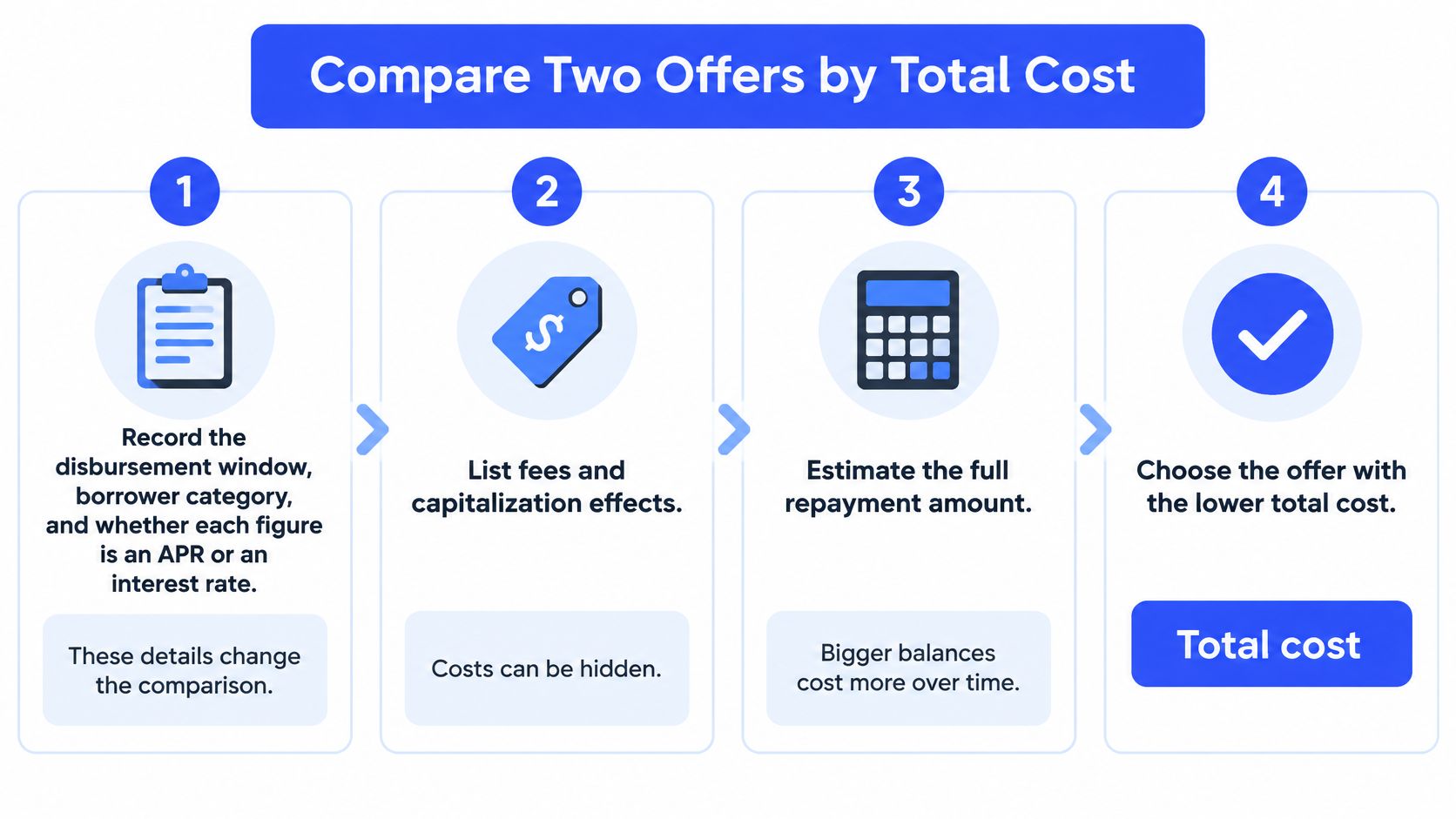
Build comparable repayment schedules
Record the loan identity. Capture the first-disbursement window, borrower category, and whether the displayed percentage is an APR or an interest rate. A fee-inclusive APR shouldn't be used as though it were the contractual rate charged to principal.
Calculate usable proceeds. Multiply principal by the proportion remaining after the origination fee. If offers supply different net amounts, adjust the comparison so both cover the same funding need.
Map the interest timeline. Mark enrollment, grace, deferment, forbearance, and repayment periods where relevant. Enter capitalization only where the applicable terms support it.
Standardize the repayment term. For a hypothetical comparison, both offers could finance the same amount over the same chosen duration. Changing the term between offers prevents a clean rate-and-fee comparison.
Calculate the full repayment amount. Sum scheduled payments and any charges paid separately. Don't add a deducted origination fee twice: the difference between principal and proceeds already captures its funding effect.
Run the capitalization sensitivity case. Recalculate using the applicable interest-addition event while holding the other assumptions constant. The difference shows the cost of that event rather than the effect of an unrelated term change.
Place monthly payment beside total repaid. A longer term can reduce the required payment while increasing lifetime interest. Affordability and total cost need separate columns because neither substitutes for the other.
Evaluate refinancing over the expected holding period. Compare cumulative savings with refinancing charges and identify when savings recover those costs. Refinancing federal debt into private debt also removes federal repayment protections, which can't be restored merely by obtaining a lower rate.
Interpret the result
For refinancing research, the Comredix student-loan refinance lender comparison provides a starting point for identifying alternatives. The borrower's actual written offers should supply the figures used in the final calculation.
A model should also distinguish total repaid from financing cost. Total repaid describes the cash leaving the borrower; financing cost compares that cash with the usable funds originally received. Holding usable proceeds constant makes the total-repaid ranking meaningful.
The final decision should favor the lowest total repayment the borrower can afford without relying on unrealistic payment assumptions. Borrow only the amount needed, pay accruing unsubsidized interest where practical, and verify that extra payments receive the intended allocation. A low percentage is useful only when the complete repayment schedule supports it.
Comredix is an independent reviews publication offering documented comparisons and practical personal-finance guides. Visit Comredix to compare borrowing alternatives, then use written lender disclosures to evaluate fees, repayment terms, and total cost before signing.
Spotted an error in this guide? Email editorial@comredix.com