Studio note · General
Air Purifier Reviews HEPA: What the Specs Really Prove
Judge air purifier reviews HEPA buyers can verify: CADR, room size and real-home results, with documented specs and seller prices.
- Updated
- November 28, 2026
- Reading
- 15 min
Most shopping guides tell buyers to look for a "True HEPA" badge first and treat everything else as a bonus. That advice gets the priority backwards. On modern air purifier reviews, HEPA is often the least informative word on the box because dozens of weak, underpowered machines carry the exact same filter label alongside capable units.
A filter material sitting inside a plastic shell doesn't clean a room on its own. Airflow speed, unit count, and room placement determine whether airborne particles ever reach that filter. In a 2021 conference-room simulation by the U.S. Centers for Disease Control and Prevention, two portable HEPA air cleaners meeting federal clean-air delivery benchmarks cut overall exposure to simulated infectious aerosols by up to 65% in a well-mixed space, and combining those units with universal masking pushed reductions up to 90%. Positioning the purifiers close to the aerosol source produced the strongest drops.
Generic marketing phrases like "captures allergens" or "removes viruses" prove nothing about how fast a machine moves air across a real bedroom or living room. Reading a listing like an analyst means shifting focus from the filter badge to verifiable delivery rates, measured home performance, and ongoing costs that filter labels ignore.
| Common listing highlight | What buyers assume it proves | Spec that actually verifies performance |
|---|---|---|
| "True HEPA" filter badge | Fast whole-room air cleaning | Tested smoke CADR at a stated fan speed |
| Advertised square-foot rating | Reliable clearing in any room layout | Independently verified room-size formula and ceiling assumption |
| "Eliminates odors and gases" | Broad chemical and smell removal | Activated-carbon bed details and pollutant-specific gas test data |
| "Auto mode" smart sensor | Hands-off peak air cleaning | Documented delivery rate on continuous everyday fan speeds |
Table of Contents
- What HEPA and CADR Really Measure
- Minimum Smoke CADR and Room-Size Claims
- Why Lab Ratings Overstate Home Results
- What HEPA Filters Cannot Remove
- Choosing a Purifier by Situation
- Confirm the Fit Before You Buy
What HEPA and CADR Really Measure
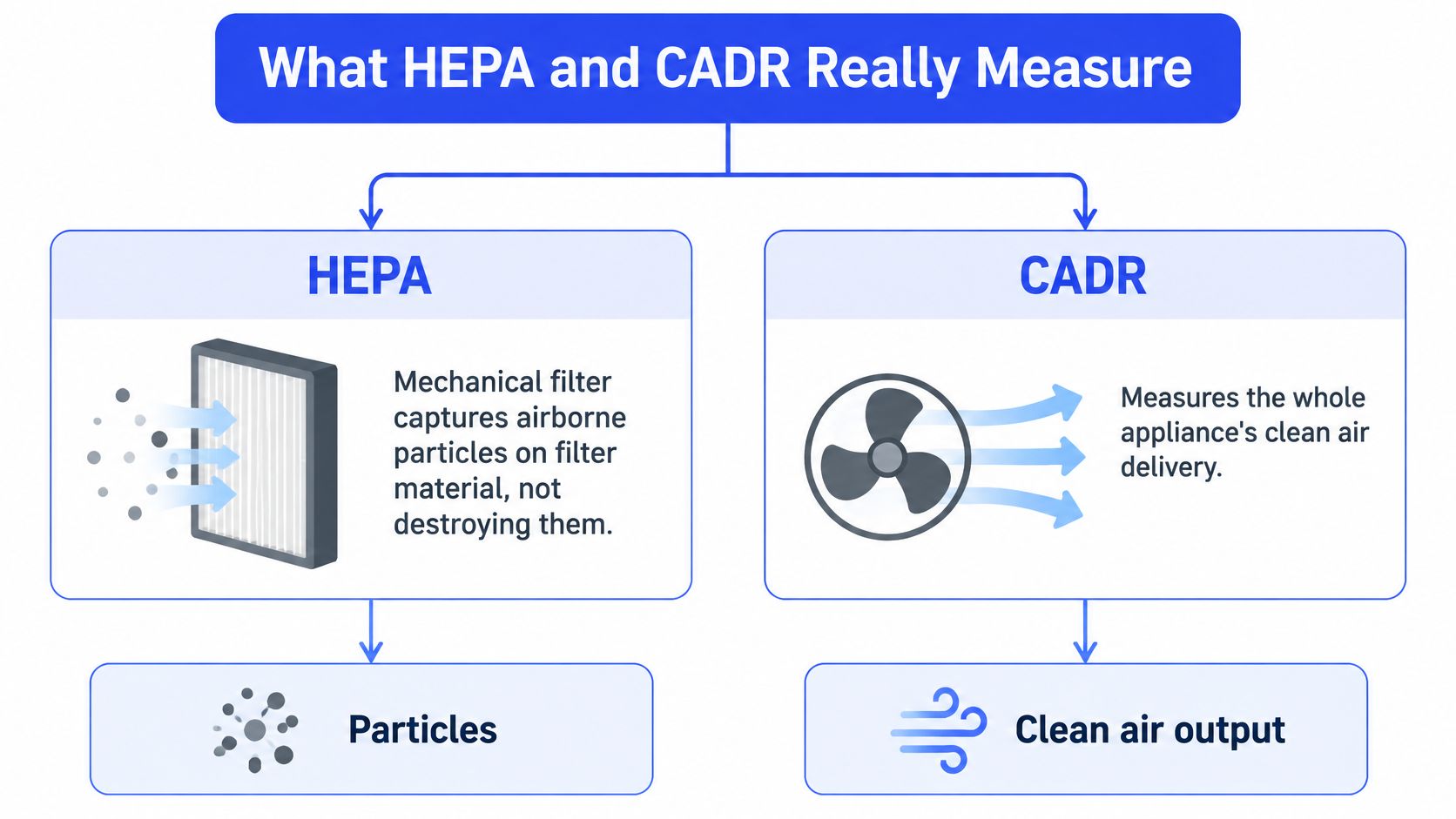
Listings routinely blur the line between a filter component and a finished appliance. HEPA stands for mechanical filtration, where dense fiber media trap airborne particles directly on the filter surface instead of destroying them chemically. According to the U.S. Environmental Protection Agency guide to home air cleaners, HEPA identifies the filter technology, while Clean Air Delivery Rate (CADR) measures how fast the complete appliance delivers filtered air.
CADR is reported in cubic feet per minute (cfm) for a specific contaminant. Under that federal guide's example, a dust CADR of 250 means the machine produces an effect comparable to adding 250 cubic feet of particle-reduced air to the room every minute. Two machines can hold identical mechanical filter paper and still deliver wildly different cleaning speeds if one pairs that media with a weak fan or a leaky housing.
Three Particle Sizes Behind One Acronym
Quoting a single generic CADR figure hides how differently a purifier handles small and large particles. Portable air cleaner testing outlined in the AHAM Verifide performance FAQs separates ratings into three distinct particle-size brackets:
- Tobacco smoke particles (0.09 to 1.0 micrometers): The finest test category, representing tiny combustion aerosols and fine particulate matter that stay suspended longest.
- Dust particles (0.5 to 3.0 micrometers): Mid-sized household debris that settles faster than smoke but still circulates during normal movement.
- Pollen particles (0.5 to 11.0 micrometers): Larger biological particles that most mechanical fans and filters clear at higher numeric rates than fine smoke.
Because pollen is far easier to capture than sub-micron smoke, a machine's pollen CADR almost always looks more impressive than its smoke CADR. For airborne virus-related aerosols, federal guidance cited in those same FAQs puts the relevant particle range at roughly 0.1 to 1 micrometer and points shoppers toward a high smoke CADR rather than dust or pollen scores. Comparing models like a Coway Airmega Mighty AP-1512HH against a compact Blueair unit only makes sense when both listings report smoke CADR on equal footing.
A Four-Point Routine for Any Spec Sheet
Evaluating air purifier reviews for HEPA units takes less than two minutes once a shopper knows which lines to audit:
- Locate all three CADR values. Look specifically for separate smoke, dust, and pollen figures instead of a single unlabelled airflow number.
- Confirm the test standard. Verify that an independent protocol produced the numbers rather than an unexplained internal factory test.
- Check the fan speed behind the rating. Most manufacturers publish maximum-speed CADR, which tells you nothing about output on quieter overnight settings unless lower-speed data appear too.
- Flag bare HEPA listings as incomplete. A product page that advertises HEPA filtration without a published CADR withholds the most basic measure of cleaning speed.
On its own, a HEPA badge tells a buyer one thing: the machine uses a mechanical particle filter. It says nothing about airflow volume, noise tolerance, filter sealing, or how much floor space the appliance can handle.
Minimum Smoke CADR and Room-Size Claims
Room sizing starts with a threshold most product pages never mention. Under the benchmarks documented in the ANSI/AHAM AC-1 portable air cleaner standard overview, every 100 square feet of floor space requires an additional 65 cfm of smoke-cleaning delivery for rooms with a standard 8-foot ceiling.
| Room area (square feet) | Minimum smoke CADR (cfm) |
|---|---|
| 100 | 65 |
| 200 | 130 |
| 300 | 195 |
| 400 | 260 |
| 500 | 325 |
| 600 | 390 |
Smoke CADR is the single benchmark to match against this table because it measures the smallest tested particle bracket and reflects how quickly a purifier strips fine pollution from indoor air. Dust and pollen scores belong on the sidelines during room-sizing checks, since a high pollen rating can disguise sluggish fine-particle delivery. The HEPA badge on the box plays no role in this math at all, because it certifies filter media rather than the volume of air moved through it.
How Independent Room-Size Math Works
Marketing departments love oversized square-footage claims because they rarely explain how fast the air gets cleaned across that footprint. Independent sizing rules remove the guesswork. As detailed in the AHAM Verifide air filtration standards, smoke CADR should equal at least two-thirds of a room's floor area in square feet. A 10-by-12-foot bedroom covers 120 square feet, which calls for a smoke CADR of at least 80 cfm.
The same technical model works in reverse to audit any seller's headline coverage claim. Multiplying a unit's smoke CADR by 1.55 yields its suggested room size, meaning a 100 cfm purifier corresponds to roughly 155 square feet. That math isn't arbitrary. It represents the capacity needed to remove at least 80% of cigarette-smoke particles in a steady-state room.
Audit check: When a product listing advertises expansive square-footage coverage alongside a modest smoke CADR, the brand isn't using the standard room-size model. It is usually counting far fewer air turnovers per hour.
That distinction hinges on air-exchange assumptions. According to the AHAM portable air cleaners and air changes per hour white paper, the verified room-size calculation sets 4.8 air changes per hour as the minimum equivalent air-exchange rate. The formula assumes continuous operation, complete air mixing, and at least 80% removal of cigarette-smoke particles measuring 0.1 to 1.0 micrometer. Drop the target to one air change per hour, and the square-footage figure a seller prints for the exact same fan and filter comes out nearly five times larger.
One number, five possible coverage claims. The CADR never changed; only the air-change assumption did, and nothing on the box forces the seller to disclose which assumption produced the headline figure.
Five Steps to Verify a Manufacturer Coverage Claim
Walking through five quick steps exposes padded math before checkout, with no lab gear required:
- Measure the room's floor area in square feet. Multiply length by width for the specific enclosed space where the purifier will run, not the entire apartment.
- Match that area to the lookup table. Pick the row that meets or exceeds your room size, and bump the target upward if ceilings rise above 8 feet because air volume grows with vertical height.
- Record the tested smoke CADR at a realistic fan speed. Confirm whether the quoted rating applies to maximum turbo mode or a lower setting someone can tolerate while sleeping or working.
- Divide the seller's claimed square footage by 1.55. Compare the result against the unit's verified smoke CADR. If the divided figure sits far above the tested smoke CADR, the listing is using looser air-exchange assumptions.
- Discount claims without CADR or operating assumptions. Any review or product page that quotes a large coverage area without publishing smoke CADR, air changes per hour, and fan speed leaves buyers guessing.
Consider two shoppers comparing a compact unit like a Levoit Core 300 against a larger Blueair machine for a 400-square-foot living room with 10-foot ceilings. Even if a compact listing advertises broad coverage at one turnover per hour, the table demands at least 260 cfm for a standard 8-foot ceiling, and the extra two feet of ceiling height pushes the required airflow higher still. Sizing by verified smoke CADR prevents buying a bedroom machine for a family room.
Why Lab Ratings Overstate Home Results
Laboratory numbers come from sealed chambers with controlled fans and uniform air mixing. Occupied homes don't behave like test chambers. Open doors, HVAC drafts, kitchen cooking plumes, outdoor smoke seeping through window seals, furniture blocking intake grilles, and human habits constantly alter the volume of air a portable machine cleans.
The gap shows up sharply when researchers track real households over time. In a randomized field study of 60 multifamily homes published in the Journal of Exposure Science & Environmental Epidemiology, portable air cleaners achieved a weekly mean particulate reduction of 66% during continuous operation, compared with just 40% when left in automatic mode. Across individual apartments, reductions swung dramatically from 14% to 100%.
| Study condition | Reported result | Reading note |
|---|---|---|
| Multifamily homes, continuous operation | 66% weekly mean reduction | Spread from 14% to 100% across apartments |
| Multifamily homes, automatic mode | 40% weekly mean reduction | Trails continuous operation by 26 percentage points |
| Range across homes | 14% to 100% | Shaped by room mixing, doors, placement, and habits |
Why Bigger CADR Doesn't Always Win Indoors
Two findings from that same body of field evidence directly challenge the "just buy the highest CADR" shortcut. First, researchers documented that a dwelling's effective mixing volume often diverges from the neat rectangular room volume plugged into theoretical CADR equations. An open doorway into a hallway or an adjoining kitchen expands the pool of dirty air without increasing the fan's output.
Second, a separate Los Angeles wildfire study noted in the same publication reported that higher CADR-to-room-volume ratios didn't consistently deliver steeper PM2.5 drops inside HEPA-equipped homes. When outdoor wildfire smoke infiltrates through leaky frames or open doors, a single high-output purifier tucked into a corner can still lose ground if air circulation stalls or occupants switch the machine down.
Placement and Consistent Use Shape Outcomes
Even a well-sized purifier fails if household members shut it off because of fan noise or glowing control lights. Real-world residential trials cataloged in a CDC residential filtration evidence summary highlight how both location and user adherence control actual air quality:
- Highway-adjacent homes: In a randomized crossover trial alternating four weeks of active HEPA filtration with four weeks of a placebo device, active units significantly cut traffic-related black carbon, PM2.5, tobacco-smoke markers, and fungal spores during 48-hour air sampling windows.
- Homes with children: Providing portable cleaners produced geometric-mean PM2.5 reductions of 65% in sleeping areas and 48% in living areas, versus 15% and 17% in control zones, even though monitored run time averaged only 34% between technician visits.
- Primary versus secondary rooms: In a randomized crossover study of households occupied by adults with COVID-19, portable cleaners cut PM2.5 by 78.8% inside primary rooms but 57.9% in secondary rooms.
A quiet purifier running all day on a steady medium speed often clears more indoor pollution than a louder high-CADR machine that gets turned off after dinner or left on sluggish auto mode.
Those field numbers change how buyers should read air purifier reviews. Always check whether a review's particle-drop percentages came from a sealed test box, a single closed room, or an occupied home. Treat CADR as an essential floor rather than a guarantee, position the intake close to the primary dust or smoke source, keep bedroom doors shut during sleep, and run the fan continuously instead of relying on onboard particle sensors to wake it up.
What HEPA Filters Cannot Remove
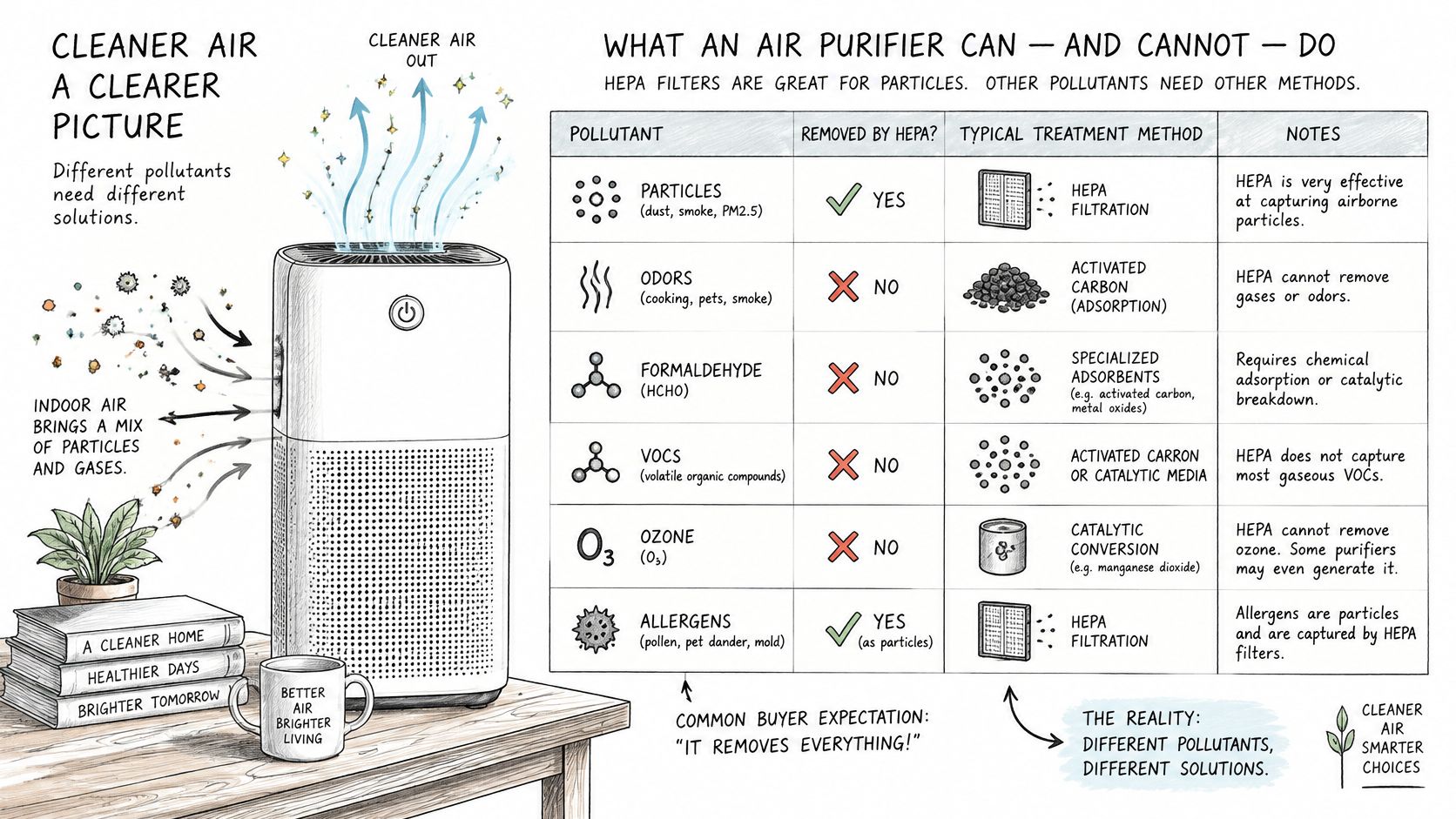
Mechanical filter media excel at trapping solid and liquid particles, yet shoppers routinely buy a single HEPA machine expecting it to wipe out pet odors, kitchen grease smells, paint fumes, formaldehyde, and volatile organic compounds (VOCs). Mechanical fibers cannot trap gas molecules. Those molecules pass straight through standard HEPA pleats like water through a chain-link fence.
Solving gas pollution requires gas-phase filtration, typically a substantial bed of activated carbon or specialized adsorbent pellets, alongside proof that the media won't saturate in weeks. Many mass-market HEPA units ship with a paper-thin carbon prefilter sprayed with charcoal dust that loses its odor-trapping capacity rapidly. Separating particle removal from gas control is the same discipline used when comparing filtration tradeoffs in other home appliances, such as Comredix's guide to bagged versus bagless vacuum cleaners.
Pollutant Mechanisms and Emerging Test Gaps
Independent testing for gases and secondary emissions lags well behind particle CADR, though regulators are working to close the gap. A 2025 research proposal submitted to the California Air Resources Board outlines plans to test 30 air-cleaning devices across 45 homes for pollutant-specific CADR, electricity consumption, ozone, VOC and ultrafine-particle emissions, gas-filter breakthrough, noise, filter life, and total ownership cost. That proposal also references a draft ASTM chemical-air-cleaner method and notes a zero-ozone certification ceiling of no more than 5 ppb.
| Pollutant or cost | Mechanism that handles it | Value to verify |
|---|---|---|
| Fine particles, allergens, smoke particles | HEPA filter | Smoke CADR at the tested operating mode |
| Odors, VOCs, formaldehyde | Gas-phase media such as activated carbon | Pollutant-specific CADR, or marked unknown if unpublished |
| Ozone emissions | Device design | Zero-ozone certification at no more than 5 ppb, or marked unknown if unpublished |
| Electricity use | Fan and motor | PM2.5 CADR per watt; Canada minimum 1.9 to 2.9 cfm/W |
Electricity and Filter Replacement Costs
Upfront retail price tells only part of the ownership story because a purifier runs continuously for years. Energy efficiency varies sharply between motors moving the same volume of air. As cited in that same California Air Resources Board proposal, Canada's energy efficiency framework sets minimum PM2.5 CADR-per-watt thresholds ranging from 1.9 to 2.9 cfm/W depending on total purifier output.
Reviews that rank purifiers solely on purchase price miss long-term operating expenses. A fair comparison adds annual electricity draw and replacement HEPA and carbon filter costs over multiple years, while keeping particle CADR and gas-phase performance in separate columns. The word "HEPA" on a box never proves odor removal, VOC reduction, or low ozone output; whenever a listing omits those numbers, treat them as unknown rather than assuming the filter covers them.
Choosing a Purifier by Situation
The HEPA stamp is the least useful figure on a listing once the room and the pollutant are known. A bedroom, a closed smoke room, a pet kitchen, and an open plan each fail for a different documented reason. The useful match starts with smoke CADR, any published home PM2.5 result, and the ownership costs that filter grade never covers.
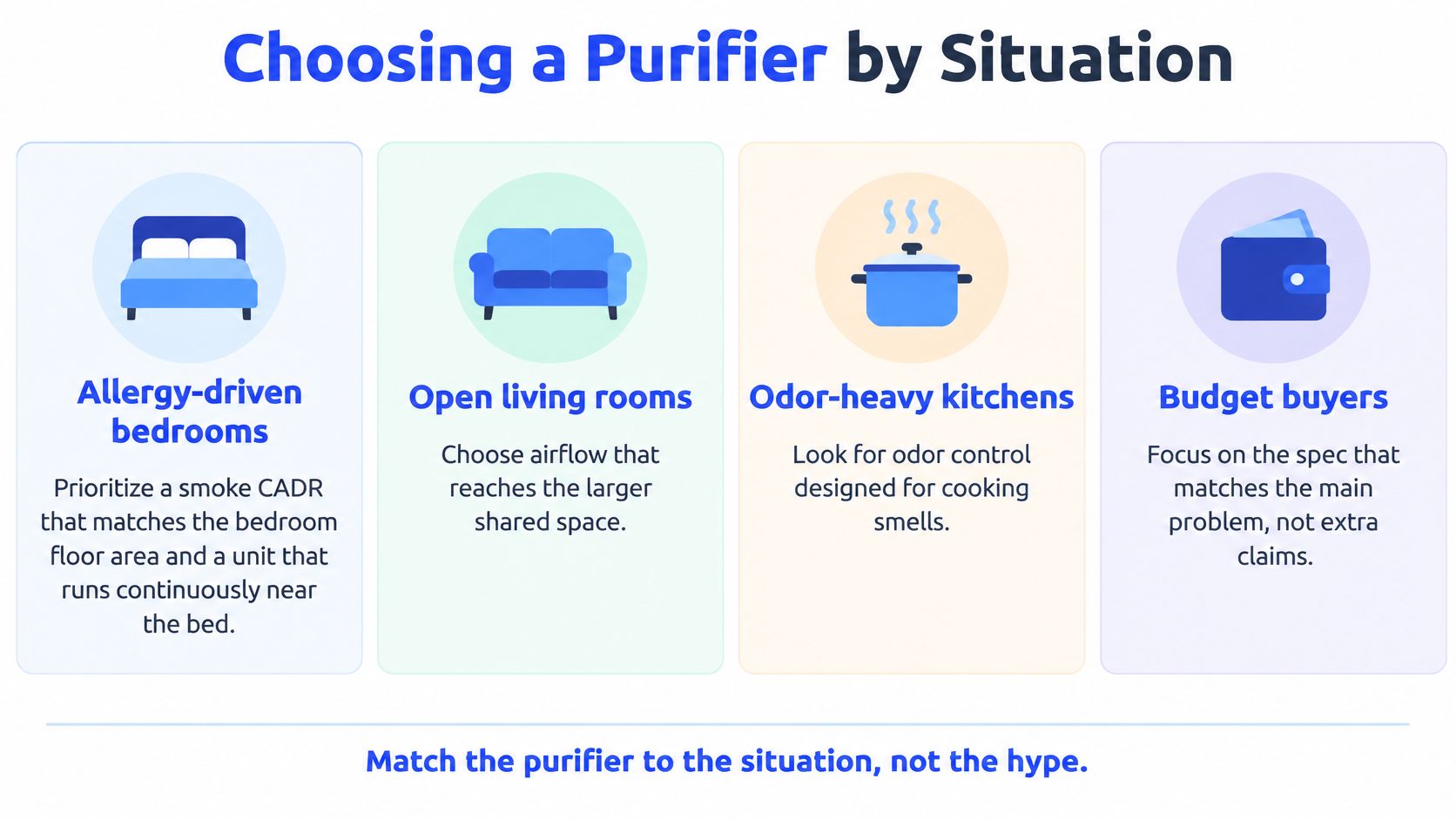
No single appliance fits every floor plan. Matching documented specs to the main household nuisance avoids paying for smart displays or oversized housings that leave the actual problem untouched.
Allergy-driven bedrooms. Dust mites, pet dander, and seasonal pollen collect where someone sleeps about eight hours. Size smoke CADR to that bedroom's floor area, set the unit near the bed with vents clear, and require a steady quiet speed plus display shutoff. A machine switched off at midnight delivers no airflow at all. Shoppers comparing mid-sized bedroom units can check documented specs in the Coway Airmega Mighty AP-1512HH review. Priority spec: bedroom-matched smoke CADR on a sleep-tolerable continuous speed.
Wildfire smoke. Fine combustion particles leak indoors through window cracks and door sweeps. Square-footage headlines matter less than fine-particle delivery, a tight filter gasket, and real-home PM2.5 evidence that a published test reports. An appropriately sized unit run continuously inside a closed-door room holds particle levels down better than one compact fan stretched across a whole house. Priority spec: high verified smoke CADR with tight mechanical filtration.
Pets, cooking fumes, or chemical off-gassing. Particle media catches pet hair and dander. Litter odor, frying grease, and formaldehyde from new furniture need gas-phase capacity. Models built for heavy gas loads, such as the Austin Air HealthMate HM400 with its deep activated-carbon and zeolite canister, exist because thin carbon sheets saturate quickly. Priority spec: substantial activated-carbon weight and published pollutant-specific gas removal data. Missing figures stay unknown.
Open-plan living areas. A connected kitchen, dining zone, and family room break single-room CADR math. Air moves into adjoining spaces, and tall ceilings add cubic feet the floor-area label ignores. One high-output unit, such as a large-room Blueair or a Winix 5520, can still struggle behind a sofa far from kitchen smoke. Check whether a write-up accounts for mixing limits, and weigh two well-placed units against one corner machine. Priority spec: high airflow, a stated placement plan, and ceiling-adjusted sizing.
Operating noise at the fan speed required to hit a target CADR, and actual filter lifespan under dirty air, often disappear from quick product roundups. A loud machine or a pricey six-month cartridge quickly undermines value even when the smoke CADR looks right on paper.
If a write-up skips decibel behavior on usable speeds, omits filter replacement frequency, or leaves out gas-phase results, mark those specs unknown instead of giving the brand the benefit of the doubt. Comredix compares documented features and published prices, never hands-on testing, and does not claim to have bought, worn, or used each product. The specification that decides the purchase still has to match the manufacturer's published sheet.
Confirm the Fit Before You Buy
A purifier that hits the minimum smoke CADR row for your room and addresses the specific pollutants in your home is the one worth comparing on price. Everything else on the product page, from app dashboards to "medical grade" buzzwords, comes second.
Three Final Purchase Gates
Before adding any HEPA air purifier to a cart, run the finalist through three quick gates in order:
- Verify smoke CADR and operating mode against your room. Confirm the tested smoke CADR matches your floor area and ceiling height, and make sure the unit can deliver steady airflow without forcing you onto a noisy turbo speed you won't run.
- Audit gas-phase and safety claims separately. If cooking odors, smoke gases, or VOCs matter in your household, check for documented activated-carbon capacity, pollutant-specific test numbers, and zero-ozone certification; treat any unpublished claim as unknown.
- Weigh seller price against ongoing operating costs. Compare the upfront retail price alongside estimated annual electricity use and multi-year replacement filter kits, since a cheap machine paired with frequent proprietary cartridges often costs more over three years than an efficient mid-range unit.
Buyers weighing finalists across categories can organize those specs side by side using a structured product comparison chart so airflow, filter costs, and missing disclosures stay visible in one view. As an independent reviews and rankings site, Comredix quotes prices in its rankings from the seller, and every statistic or price in a reliable buying guide should link directly to its original publisher or the seller's own page. Always reconfirm the live price, filter availability, and exact model number on the seller's page right before ordering, because retail pricing and bundled filter configurations shift frequently.
Comredix publishes independent product rankings, documented specification comparisons, and seller-sourced pricing across home equipment and eleven other categories without relying on unverified hype. Buyers comparing air purifiers can check verified specs, weigh ongoing filter costs, and trace every quoted number back to its publisher on Comredix.
Comredix. (2026, November 28). Air Purifier Reviews HEPA: What the Specs Really Prove. https://comredix.com/air-purifier-reviews-hepa
Spotted an error in this guide? Email editorial@comredix.com