Studio note · General
Payment Gateway vs Payment Processor Guide
Payment gateway vs payment processor: roles, real fee layers, PCI duties, and which setup fits a store in 2026.
- Updated
- November 21, 2026
- Reading
- 14 min
A payment gateway captures card details at checkout and sends them onward, while a payment processor routes the authorization through the banks and card networks and moves the settlement money afterward. Two jobs, two contracts, and two different sets of responsibilities sit inside a single tap of a buy button.
The size gap between the layers is the first clue. Research and Markets values the payment processing solutions market at US$121.8 billion in 2025, with a projection of US$557.8 billion by 2034, while its payment gateway market estimate puts that layer at US$46.4 billion in 2025 and a projected US$159.6 billion by 2032. The infrastructure side is the larger business because it carries the banking relationships, the network connections and the regulatory weight.
That imbalance is why the brand on the dashboard rarely settles the decision. What decides the outcome is who owns routing, settlement, tax, refunds and chargebacks, and how well the data attached to each transaction holds up when a network prices it. A merchant who answers those four questions can buy from almost anyone. A merchant who doesn't will keep paying for the gap.
Table of Contents
- Gateway and Processor Roles Side by Side
- How a Card Payment Travels
- Fees That Actually Hit the Statement
- Approval Rates Latency and Compliance
- Who Answers When a Payment Goes Wrong
- Setups That Fit Real Stores
- Pick the Layer Before the Brand
Gateway and Processor Roles Side by Side
The working split fits in two sentences. A payment gateway is the merchant-facing technology layer: it captures payment details at checkout, encrypts or tokenizes them, and sends an authorization request into the payments network. A payment processor is the infrastructure provider that routes that request between the merchant's acquiring bank, the card network and the issuing bank, returns an approval or decline, and helps move settlement funds, as the Nilson Report's account of both roles sets out.
Think of the gateway as the digital equivalent of a point-of-sale interface and the processor as the engine handling authorization, routing, clearing and settlement behind it. Card payments grew through separate participants, merchants, merchant acquirers, issuing banks and card networks, rather than through one universal intermediary. That history explains why the duties still attach to different institutions even when one vendor sells both under a single contract.
| Job in one card payment | Payment gateway | Payment processor |
|---|---|---|
| Capture payment details | Yes, at the checkout page | No |
| Encrypt or tokenize data | Yes | Receives already secured data |
| Send the authorization request | Yes | Routes it onward |
| Reach acquirer, network and issuer | Through the processor | Yes |
| Return approval or decline | Passes the response to checkout | Obtains and returns it |
| Clearing and settlement | No | Yes |
| Checkout experience | Primary effect | Indirect |
| Dispute operations | May notify the merchant | Supports dispute handling with the acquirer |
What each layer changes for the merchant
Gateway choice shapes integration options, hosted checkout, tokenization and the shopper's experience at the moment of payment. Processor choice shapes connectivity, authorization performance, settlement, dispute handling and the merchant's access to card-network rails. A store can, in principle, change one without touching the other, though the contract terms often decide how practical that really is.
Practical rule: When a single provider is named on the contract, ask which legal entity is the acquirer of record and which one returns the decline.
Why the label doesn't settle the regulatory question
U.S. debit rules define a payment card network by its role in routing transaction information between an acquirer and an issuer for authorization, clearance and settlement. The official commentary adds that a processor can be treated as a payment card network when it performs that routing function, as Regulation II in the eCFR states. The word "processor" on a website therefore doesn't describe every technical or regulatory role a provider performs. Its actual routing and settlement functions decide how the transaction is treated.
Bundled contracts sell both jobs while the responsibilities stay separate. A gateway vendor is not automatically the institution that approves a card or settles the funds, and a merchant who reads a contract as if it were will find out at funding time.
How a Card Payment Travels
A shopper types a card number into a checkout form. The gateway tokenizes or encrypts those details, may run its own fraud screening or push the cardholder through 3-D Secure, and forwards an authorization request. Everything after that happens on rails the shopper never sees.
The five handoffs in that path are worth keeping in view, because each one belongs to a different party.
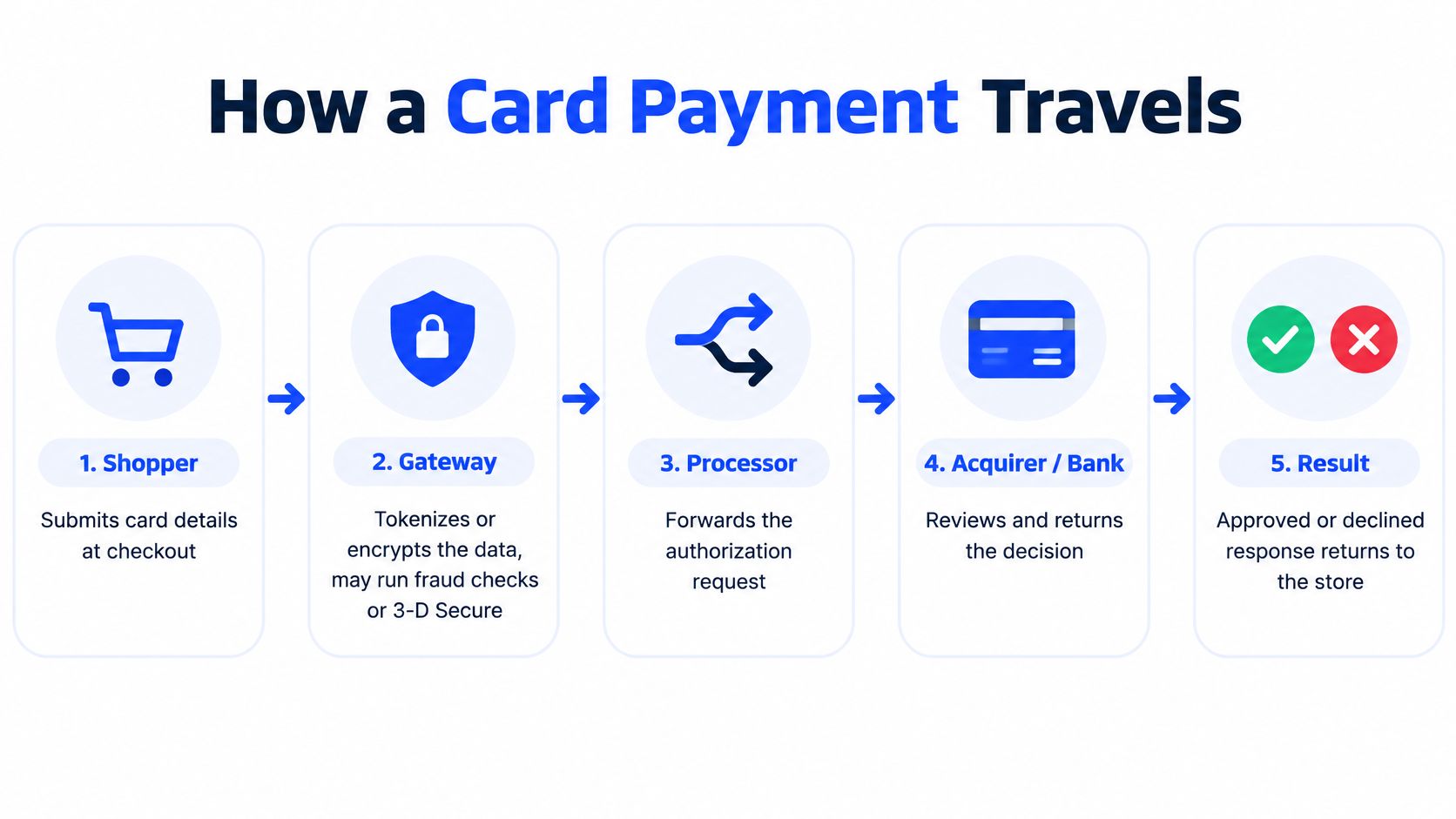
The processor or acquiring bank routes the request to the matching card network, then to the issuing bank that holds the account. The issuer approves or declines, and the decision travels back through the processor and the gateway to the page in front of the buyer. Clearing and settlement follow later, moving funds toward the merchant net of the fees that show up on the statement.
Why one processor connection rarely covers the world
In 2022, worldwide card networks generated $40.645 trillion when purchase volume was combined with credit-card cash advances and debit withdrawals, the first year global payment-card volume exceeded $40 trillion, according to Nilson data reported by GlobeNewswire. Of the $36.174 trillion in goods-and-services purchase volume, UnionPay accounted for $15.843 trillion, Visa $11.668 trillion, Mastercard $6.568 trillion and American Express $1.540 trillion.
Transaction shares show the routing pressure in a different unit. Visa held 39% of global purchase transactions in 2022, UnionPay 34% and Mastercard 24%. A merchant that connects to one network well and the others badly is exposed on roughly half its volume, which is the core argument for a processor with broad network reach.
A gateway can't replace any of this. It's the connection point through which a site or app submits payment data, and it can present several methods and processors behind one integration. The processor talks to the matching network and banks, applies authorization and risk controls, and supports settlement. The sequence below follows the same path from the shopper's side.
The same handoffs, followed from the checkout page back to the bank decision, play out in this walkthrough.
For merchants, the consequences split cleanly. Gateway selection leans on integration options, hosted checkout, tokenization and payment-method coverage. Processor selection leans on acquiring relationships, geographic reach, acceptance rates, transaction routing, funding timing and processing cost. Two layers, two scorecards.
Fees That Actually Hit the Statement
The bill on a card payment is a stack, and only some layers are negotiable with the company a merchant signs with. The published figures below are the ones a merchant can check, split by who sets them.
| Fee layer | Who sets it | Published figure | What changes it |
|---|---|---|---|
| US covered debit interchange | Regulation II | $0.21 + 0.05%, plus up to $0.01 fraud adjustment | Issuer coverage and the fraud-prevention adjustment |
| EU consumer debit interchange | Regulation (EU) 2015/751 | 0.2% | A member state may allow up to €0.05 fixed when combined with the cap |
| EU consumer credit interchange | Regulation (EU) 2015/751 | 0.3% | The cap covers interchange only, not the full merchant fee |
| Commercial-card data example | Visa rules, industry reporting | About $8.85 verified vs $13.60 downgraded on $500 | Missing Level 2 or Level 3 data, roughly 54% higher |
Two layers are absent from that table for a reason. The gateway fee and the processor markup carry no universal published figure: each seller prices them per contract, and the numbers depend on what the merchant buys. Hosted checkout, tokenization and per-transaction add-ons move the gateway line. The choice between flat rate and interchange-plus moves the markup. Both sit in the negotiated part of the stack, so the reliable reading is on the seller's current pricing page rather than in any benchmark.
In the United States, covered debit issuers face a regulated ceiling of $0.21 plus 0.05% of transaction value, with a possible $0.01 fraud-prevention adjustment, as a PR Newswire release carried by Morningstar reports. That ceiling applies to interchange, the fee exchanged between payment service providers. The processor's markup and the gateway's charge sit outside it.
Where data quality moves the rate
The same reporting tracks a Visa change that added a 5-basis-point participation fee for certain Level 2 and Level 3 commercial-card transactions in April 2025, with automated data validation following in October 2025. In the $500 example it cites, a verified rate came to about $8.85 against $13.60 after a downgrade. That's a 54% increase from missing data fields, not from a change of provider.
One column in the table captures the whole argument: what changes the fee. A merchant can negotiate markup and shop gateways, but a failed data field raises the effective rate more than most contract terms ever will.
In the European Union, the rules are equally specific. The EU summary of the card fee regulation caps consumer debit-card interchange at 0.2% and consumer credit-card interchange at 0.3%, and a member state may permit a domestic consumer debit fixed fee of up to €0.05 when combined with the percentage cap. These are limits between providers. Network assessments, processor markup, gateway fees, currency conversion, chargeback fees, reserves and settlement costs all sit on top.
Audit the stack, not the headline: interchange, assessments, markup and gateway charges are four separate lines, and only two of them usually come from the company a merchant signs with.
Flat rate is a preference, not a verdict
Neither pricing model wins outright. A small or low-volume store that wants a predictable bill can be well served by a flat rate, because the administrative cost of auditing enhanced data fields may exceed the savings. A seller with high-ticket commercial-card volume often saves more by fixing Level 2 and Level 3 pass rates and routing than by switching gateways for a few basis points.
Comredix copies prices from sellers' pages on the date shown and links every statistic to its publisher, so any figure above can be traced to the page that states it. A gateway fee or processor markup that isn't published isn't a universal price; it's a quote to read on the seller's current page.
Approval Rates Latency and Compliance
Authorization performance is a joint outcome of gateway orchestration and processor or acquirer routing. It is not a badge a processor can hand over on its own, and it isn't stable across markets.
Two panels explain why the number moves.
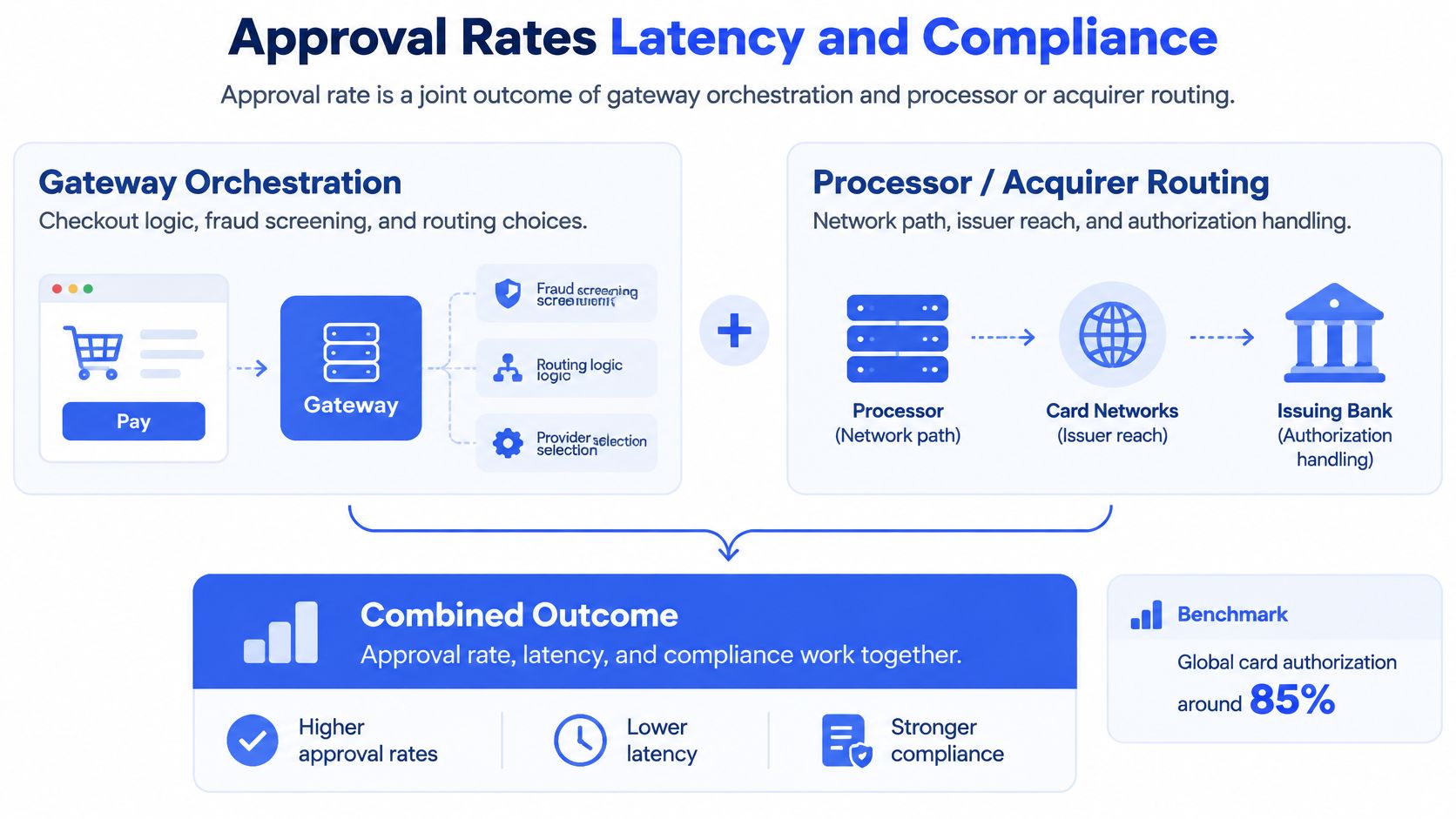
A published benchmark places general global card-payment authorization at roughly 85% to 90%, while merchants with optimized processing reach approximately 91% to 96%, and top performers in selected industries may exceed 97%, according to Shopify's benchmark review of authorization rates. The useful version of that number is approval rate by country, issuer, card type, currency and decline code. A blended global figure hides exactly the declines a merchant could fix.
Split the number before trusting it
Gateway levers include intelligent routing, network tokens, localized acquiring, account updater support and controlled retries on recoverable soft declines. Processor levers include issuer connectivity, merchant-category routing, settlement corridors and response reliability. Neither list substitutes for the other, which is why a single "payment provider" label proves nothing about either capability.
Decline patterns also carry fraud signal. Comredix maintains a reference set of online fraud statistics that pairs published figures with their original sources, useful when a spike in declines needs to be separated from a spike in attempted fraud.
Latency belongs on the same scorecard
Measure end-to-end latency from checkout submission through authentication, fraud screening, gateway response and processor response. Consistent sub-second responses for most transactions read as competitive, and fragmented integrations or overloaded providers create variance that shows up worst during peak trading. A merchant who only tests at 2pm on a Tuesday has no evidence for the Friday before a sale.
Report card to demand: authorization rate, p95 and p99 latency, timeout rate, retry recovery rate, and cost per successful transaction, each broken out by market.
Outsourcing processing doesn't outsource PCI
Merchants keep PCI DSS duties even when a processor handles the card data. They verify the provider's compliance, maintain a written responsibility agreement, monitor the provider at least annually, and validate their own applicable scope, often through a self-assessment questionnaire, even when card data is never stored locally.
Score gateway evidence on API quality, hosted fields, tokenization, 3-D Secure support, webhooks and checkout uptime. Score processor evidence on acquiring coverage, network connectivity, settlement currencies, decline-code quality, dispute handling and reconciliation. Two columns, two sets of questions.
Who Answers When a Payment Goes Wrong
Technical definitions rarely survive a chargeback. A conventional processor generally leaves the business as the seller, responsible for taxes, refunds, disputes, fraud controls and regulatory compliance, while a merchant of record can assume those obligations, including tax handling, chargebacks and compliance, as Slash's comparison of merchant of record services describes. The difference is legal and operational before it is technical.
The name on the customer's card statement is a responsibility clue, not a branding detail.
Two businesses, two answers
A domestic retailer with a finance team and one main market usually keeps a gateway plus processor arrangement. It holds the margin, keeps the customer data, and absorbs the tax filing and dispute work because it has people who can do it.
A small software seller trading in several countries often pays a higher merchant-of-record percentage and comes out ahead. That fee replaces tax registration, local payment rules, customer support, dispute administration and foreign-exchange exposure, none of which appear on a rate card.
Bullet the decision questions instead of arguing them:
- Statement descriptor: whose name does the cardholder see, and who fields the call when it's unfamiliar?
- Refund authority: who can issue a refund without approval from someone else?
- Chargeback ownership: who writes the response, supplies the evidence and absorbs the loss?
- Indirect tax: who registers, calculates and remits it in each jurisdiction?
- Data control: who holds transaction-level data, and who can export it?
- Suspension risk: what happens to payouts and customer access if the account is frozen?
The test before the shortlist
The cheapest processing rate is not automatically the lowest total cost. A gateway-plus-processor stack preserves control and margin only when the company can staff compliance, disputes and tax. A merchant-of-record model costs more per transaction and hands over part of the customer relationship in exchange for someone else carrying those duties. Run this matrix before comparing brands, not after.
Setups That Fit Real Stores
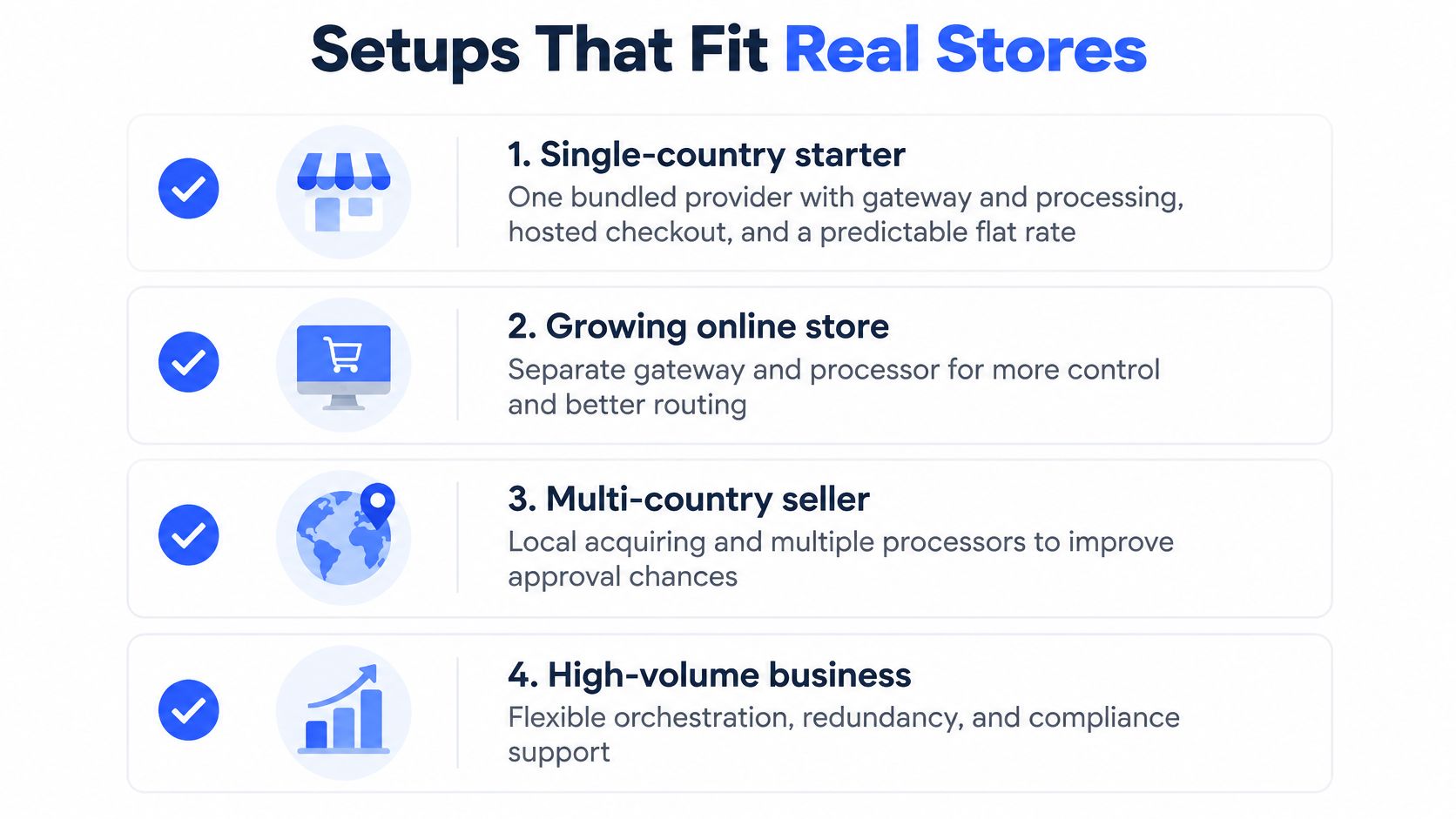
The same provider can be the right answer for one store and the wrong answer for another. Four situations cover most of the market, and each points to a different layer to buy first. A store that picks the wrong layer pays for it in tax work, disputes and lost margin long after the quoted rate stops mattering.
The four setups below map each situation to the layer to buy first.
| Situation | Setup that fits | Main reason | Check before signing |
|---|---|---|---|
| New single-country shop | Bundled gateway and processor | Predictable pricing and one integration | Hosted checkout, funding time, contract exit |
| Commercial-card volume | Named processor with data-quality reporting | Downgrades can outweigh gateway fees | Level 2 and Level 3 pass rate |
| Cross-border digital goods | Merchant of record or a staffed in-house stack | Tax and disputes can exceed the rate gap | Who remits tax and answers chargebacks |
| Platform enabling other sellers | Gateway only, processor, or facilitator model | Underwriting and the payee change | Who is the merchant of record |
Each row answers a different ownership question.
A new single-country shop with modest volume is usually best served by one bundled provider covering both layers, a hosted checkout and a flat rate. Separate contracts add administrative work before they add margin, and at low volume the margin being optimized is small. A shop still choosing its storefront software can compare options in Comredix's ranking of ecommerce platforms for SEO before locking in the payment stack built on top.
A growing store with mixed consumer and commercial cards should keep the gateway and the processor identifiable inside whatever bundle it buys. Ask for interchange-plus reporting, push Level 2 and Level 3 data through, and treat a lower sticker rate as worth less than a cleaner data field. Downgraded transactions raise the effective fee even when the advertised rate stays flat. That is an evidence problem, and no rate negotiation fixes it.
The deciding evidence for any row comes down to a short list:
- Checkout methods: which cards, wallets and local methods appear without a second integration.
- Settlement currency: what the merchant is funded in, and who carries the conversion.
- Decline codes: whether the response says enough to fix the transaction.
- Funding speed: how many days between the sale and usable cash.
- Dispute workflow: whether a chargeback arrives with enough detail to answer it.
A platform or software company letting other businesses sell has a different question. It needs to know whether it is only integrating a gateway, holding a processor relationship, or operating closer to a payment facilitator, because the label changes the underwriting and changes who the end customer pays. Comredix's Selling online category covers store builders, Shopify themes and apps, payments, shipping and the tools behind online stores across 12 rankings, giving readers a place to compare documented options once the setup is chosen.
Pick the Layer Before the Brand
The order of decisions matters more than the shortlist. Four checks settle the layer before any provider name enters a spreadsheet.
- Name the missing job. Is the gap checkout capture, bank and network routing, or legal ownership of tax and disputes? Each answer points to a different layer.
- Match it to one setup row. A starter shop, a commercial-card seller, a cross-border digital seller and a platform enabling other sellers buy differently.
- Request the current paperwork. Ask the shortlisted seller for the fee schedule, settlement currencies, reserve policy and the statement descriptor.
- Confirm the responsible party. Write down who handles refunds, chargebacks and tax, then compare only providers that accept that duty.
Practical rule: If nobody can name the party responsible for refunds, chargebacks and tax, the brand comparison is premature.
Comredix states that makers change prices, plans and terms often, so readers should check the price on the maker's site before they buy or upgrade. Comparisons still carry weight. They run on capabilities and responsibilities first, with the copied number confirmed at the source.
The layer decision holds for years. The rate on the page rarely does.
Comredix publishes side-by-side comparisons of payment gateways and payment processors built from documented features and quoted seller prices, so the routing, settlement, dispute and reporting questions above can be checked against named providers and their published terms. A store ready to buy at the gateway layer can work from Comredix's ranking of payment gateways for small businesses, while the wider payment and selling categories on Comredix cover the tools that connect to either choice.
Spotted an error in this guide? Email editorial@comredix.com