Studio note · General
How to Choose a Stroller in 2026: Safety First
How to choose a stroller in 2026: safety checks, age fit, brakes, route and budget, plus an in-store test you can run before paying.
- Updated
- November 23, 2026
- Reading
- 12 min
Forty-four of the 73 baby strollers tested in a coordinated European compliance investigation failed at least one requirement, according to the European Commission's baby-stroller safety project. The samples weren't a random survey of everything on sale, but the finding makes the buying priority clear: documented safety comes before appearance.
Knowing how to choose a stroller means checking the exact model against the child, the daily route and the conditions outside. A small fold won't solve broken pavement, and an impressive canopy won't guarantee airflow. The useful features are the ones a caregiver can verify before paying.
Table of Contents
- Start With a Safety Checklist That Rules Out Weak Models
- Match the Stroller to Your Child's Age and Stage
- Choose the Stroller Type Before the Features
- Test the Stroller in the Shop Before Paying
- Fit the Stroller to Your Route, Car and Transit
- Heat, Canopy and Airflow for Hot Weather
- Spend Your Budget on the Features That Decide Safety
- Confirm Your Shortlist Before You Buy
Start With a Safety Checklist That Rules Out Weak Models
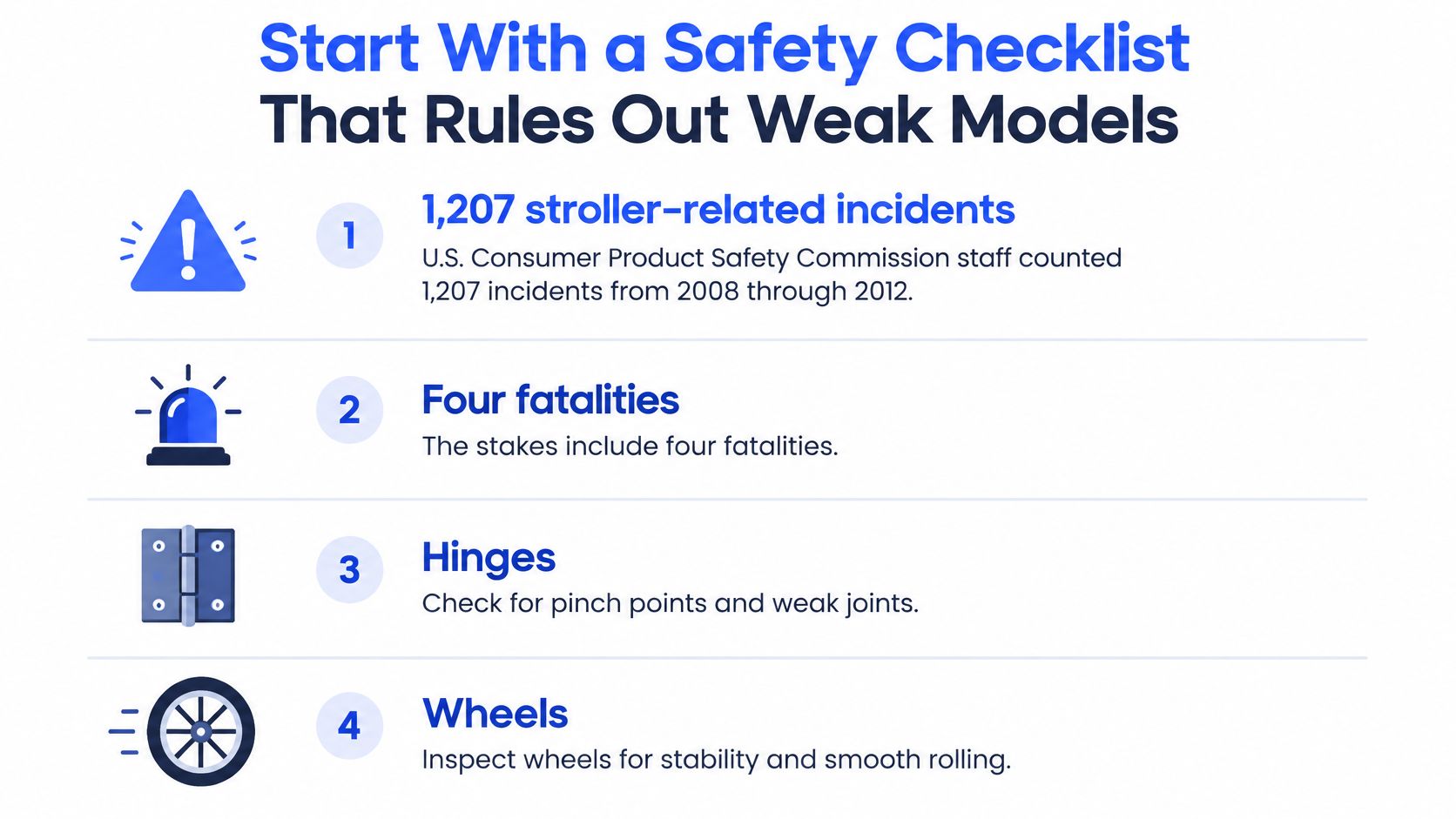
U.S. Consumer Product Safety Commission staff identified 1,207 stroller-related incidents reported from January 2008 through December 2012, including four fatalities, in the CPSC's stroller safety review. Hinges, wheels and locking mechanisms recurred in the injury reports.
That history makes safety an elimination exercise, not a score that attractive extras can offset. A model failing any check below comes off the shortlist before price or colour enters the discussion.
Stroller safety checklist before comparing features
| Check | What to verify | Red flag |
|---|---|---|
| Safety standard | Documentation names the applicable rule, such as the U.S. federal rule incorporating ASTM requirements or EN 1888 in Europe | No stated standard or certificate for the exact model |
| Five-point harness | Contact points at shoulders, waist and between the legs, with a buckle an adult can open but a child cannot | Lap belt only or an unspecified restraint |
| Parking brake | Engages and locks both rear wheels | Brake locks one wheel or releases with light pressure |
| Fold lock | Locks securely when folded and when unfolded | Lock feels loose or slips under light force |
| Wheels and hinges | Joints and wheels stay stable under load, and wheels turn freely | Visible play at hinges or a wobbling wheel |
| Recall status | Exact model checked against official recall listings | Open recall or status cannot be confirmed |
Check documentation and hardware together
A compliance statement should identify the stroller being purchased, not merely the manufacturer. Match the model identifier on the frame to the manual and sales listing, including the seat, carrycot and adapters in the intended configuration.
A showroom display can have a different attachment or production version from the boxed product. Ask to see the documentation for the actual item rather than accepting a nearby badge as proof.
The visual checklist highlights the parts that deserve close inspection.
New upholstery doesn't establish structural condition, and a substantial-looking frame doesn't prove reliable locking. Conversely, low weight alone isn't a reason to reject a stroller if its documentation and mechanisms pass inspection.
Buying rule: If the manufacturer cannot show documented compliance for the exact model and configuration, move on.
Match the Stroller to Your Child's Age and Stage
A newborn needs an approved lie-flat configuration. The UK National Health Service says pushchairs are suitable for young babies only when their fully reclining seats allow the baby to lie flat.
A from-birth label isn't enough on its own. Check whether that claim applies to the supplied seat or requires a separate carrycot, insert or attachment.
Seat and harness check by stage
| Stage | Seat requirement | Harness check | Upgrade trigger |
|---|---|---|---|
| Young baby | Fully reclining seat that lies flat, or an approved newborn configuration | Five-point harness with an adult-openable buckle where the configuration specifies a harness | Lie-flat position is no longer available |
| Older baby | Upright seat with a recline the caregiver can set | Five-point harness adjusted to the child | Child reaches the stated weight or height limit |
| Child who can reach the buckle | Upright seat appropriate to the child's stage | Buckle the child cannot open | Replace the stroller if secure restraint cannot be maintained |
Consumer Reports' stroller buying guide identifies the five-point harness as the safest stroller restraint arrangement. It secures the shoulders, waist and area between the legs; the buckle should be manageable for an adult and difficult for a child to release.
Plan for the next transition
Compare the manufacturer's age, height and weight limits with the child's current size and likely growth over the next year. Moving from a carrycot to an upright seat should follow the configuration's developmental requirements, not a calendar guess.
Adding a sibling platform also changes the load and available walking space. Confirm that the platform is approved for the exact frame.
A stroller carrycot shouldn't automatically be treated as a replacement for a separate sleep product. Families comparing home sleeping arrangements can consult the Comredix bassinet comparisons.
Before comparing models, answer:
- Seat position: Does the newborn configuration lie flat?
- Restraint: Which harness does the seat use?
- Growth allowance: How close is the child to the stated upper weight limit?
Choose the Stroller Type Before the Features
Choose the carrying format first. Stroller categories overlap, so the label matters less than the equipment included and the compromises involved.
| Type | Where it fits | What needs checking |
|---|---|---|
| Full-size pushchair | Longer walks, rougher pavement and outings requiring more storage | Larger wheels and baskets can mean more lifting weight and a bulkier fold |
| Compact or lightweight stroller | Buses, stairs and limited storage | Smaller baskets and lighter frames may be less useful on uneven ground |
| Travel system | Families moving regularly between car and stroller | Car-seat compatibility, approved adapters, separate limits and recall status |
| Carrycot or lie-flat configuration | Very young babies needing an approved newborn setup | Actual recline, attachment security and whether the required components are included |
A full-size model isn't automatically easier to push, and a compact model isn't automatically easy to carry. Handle height, wheel behaviour and the position of the carry grip can change the practical result.
Travel systems deserve particular care. A compatible car seat is a transport option, not a reason to disregard its own instructions or treat it as a general sleeping space.
The right stroller type fits the ordinary journey, not the most ambitious outing on the family calendar.
Every category must pass the same safety requirements. The deciding differences are how the stroller handles the route and whether it fits the car boot without an awkward dismantling routine.
Test the Stroller in the Shop Before Paying
Test the exact configuration being purchased, with the retailer's permission and no child inside during folding, lifting or load checks. Use a controlled area, keep fingers away from hinges and ask staff to demonstrate unfamiliar mechanisms.
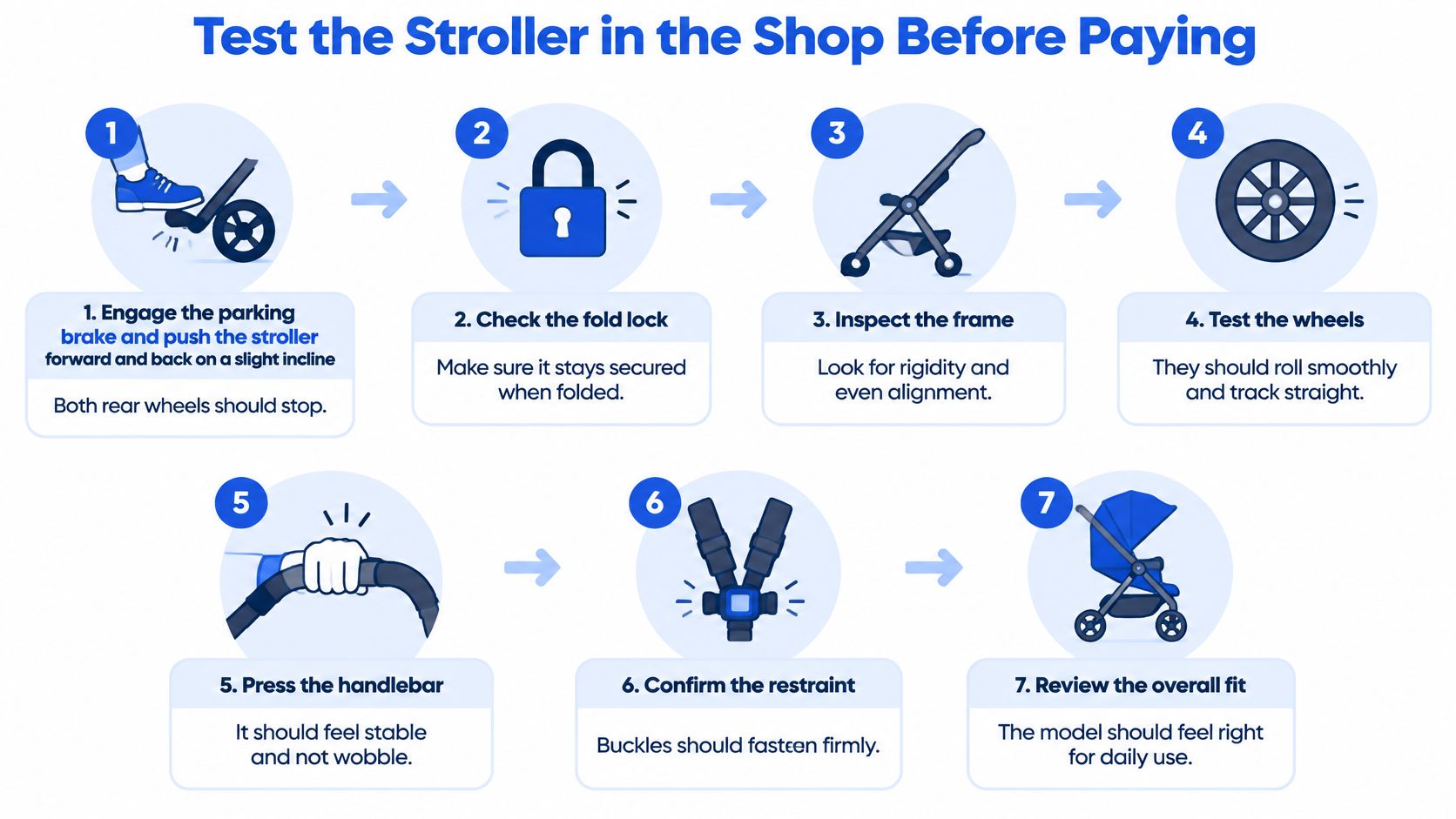
The illustrated sequence provides a visual reminder of the components to handle.
Run the mechanical checks
Engage the parking brake and push forward and back on a slight incline. Both rear wheels should remain stopped; a brake that only appears secure on a level showroom floor hasn't answered the important question.
Push against the handle with one hand. The frame should remain aligned without unexpected wobbling or pulling, because steering corrections become harder with a loaded basket.
Fold and unfold the stroller three times. Confirm that the appropriate locks engage each time and resist a light accidental push, because inconsistent engagement can conceal a collapse hazard.
Lift the empty stroller by the designated frame or carry point. Check hinges and wheel attachments for unexplained play, since looseness may be less obvious while the stroller rests on the floor.
Buckle, adjust and release the harness. Try the accessible release surfaces without forcing them; reject a buckle that a child could readily operate, because an easy escape defeats the restraint.
Check resistance to accidental brake release. The federal stroller safety standard describes a single-action release mechanism that must resist 10 lbf (45 N) applied directly in the release direction; this is a compliance-test requirement, not something a shopper can certify by pressing with a foot.
Load the basket within its stated limit and repeat the brake and folding checks. Use retailer-approved weights and follow any instruction to empty the basket before folding, because the permitted load configuration must remain practical and stable.
Consumer Reports' brake guidance recommends parking brakes that are easy to operate and lock both rear wheels. Check pedal access in the footwear normally worn on walks, rather than judging convenience from the mechanism's appearance.
Reject inconsistent operation
A familiar brand doesn't excuse a slipping lock or an unreliable buckle. For a second-hand stroller, missing instructions, altered parts or uncertain replacement components are reasons to pause the purchase.
A demonstration video can help identify operations to discuss with the retailer, but it doesn't replace checking the actual unit.
Fit the Stroller to Your Route, Car and Transit
Stairs, missing elevators, narrow gates and crowded buses can make a well-equipped stroller the wrong purchase. Broken pavement creates a different problem: the easiest model to carry may demand more effort to steer.
A 2025 study examining 14 U.S. transit systems found that stations often lack child-friendly design and that policies and infrastructure inadequately support strollers and other assistive devices. A portability claim can't account for the barriers on a particular commute.
Stroller features by daily situation
| Situation | Features to prioritise | Trade-off |
|---|---|---|
| Buses, stairs and narrow gates | Compact fold, light carry weight, narrow width | Lighter frames can feel less stable on rough pavement |
| Broken or uneven sidewalks | Larger wheels, stable frame, reliable two-wheel brake | Bigger models are harder to lift onto transit |
| Small car boot | Small folded footprint, one-hand fold | Compact folds usually offer less basket space |
| Twins or siblings | Footrest spanning the seating area, stable frame under load | Wider platforms need more door width and storage |
| Heavy shopping and bags | Usable under-seat basket, no reliance on handle hooks | Basket load limits still apply |
Measure the complete stroller
Bring a tape measure and record the narrowest doorway or gate, lift opening and usable boot space. Compare those measurements with the stroller in its actual folded configuration, including wheels and any seat that stays attached.
Check actual carry weight, not chassis weight alone. A frame specification may exclude the seat and accessories that must travel with it.
Boot shape matters as much as volume. A stroller that fits only after removing wheels may be acceptable for occasional trips but irritating during daily school runs.
Run a one-caregiver rehearsal
With the child safely cared for elsewhere, lift the folded stroller and step through a representative gate or rehearse boarding at a stationary, permitted location. Check whether the carry handle leaves the brake or wheels rubbing against clothing and whether a removable seat creates another awkward item to manage.
The American Academy of Pediatrics' stroller guidance warns against hanging bags from the handle because of tip-over risk. Pack the intended shopping into the basket instead, then check access with the seat reclined.
A compact, one-hand-fold model usually makes more sense for daily transit. A heavier model with better-performing wheels is often the more useful compromise for long walks on rough pavement, provided the caregiver can manage its storage and lifting demands.
Heat, Canopy and Airflow for Hot Weather
A bigger sun cover isn't necessarily better. Shade blocks sunlight, but ventilation allows air to move around the child. Fabric draped across the opening can interfere with that airflow.
The following changes in internal air temperature were measured in an experimental stroller heat study indexed by PubMed: dry muslin increased temperature by 2.6°C, flannelette increased it by 3.7°C, and moist muslin with a battery-powered clip-on fan reduced it by 4.7°C versus standard practice.
Measured internal temperature change by cover setup
| Cover or setup | Internal temperature change | What it means for buyers |
|---|---|---|
| Dry muslin cloth draped over stroller | +2.6°C | Fabric shade alone can raise the temperature |
| Flannelette cloth draped over stroller | +3.7°C | A heavier covering isn't a reliable cooling solution |
| Moist muslin with battery clip-on fan | -4.7°C versus standard practice | Airflow combined with evaporative cooling performed differently from dry covering |
These experimental results aren't a promise for every climate or stroller. They don't justify enclosing a child behind an improvised covering, even with a fan.
Inspect the airflow path
Open the canopy and locate the mesh panels. Check whether air can move through the occupied area rather than merely through a small viewing flap above it.
- Canopy geometry: Look for shade that leaves an open air path.
- Visibility: Confirm that the child remains easy to monitor.
- Fan attachment: Check secure mounting, inaccessible blades and cords, and compatibility with the frame.
- Configuration: Compare the openness of the seat with the enclosure of the carrycot.
Local humidity, walking duration and the expected hottest conditions should influence the choice. Sunscreen is a separate consideration from stroller ventilation; the Comredix kids' sunscreen comparison addresses that product decision.
Choose ventilation that works with the intended cooling approach, not a canopy that only looks protective.
Spend Your Budget on the Features That Decide Safety
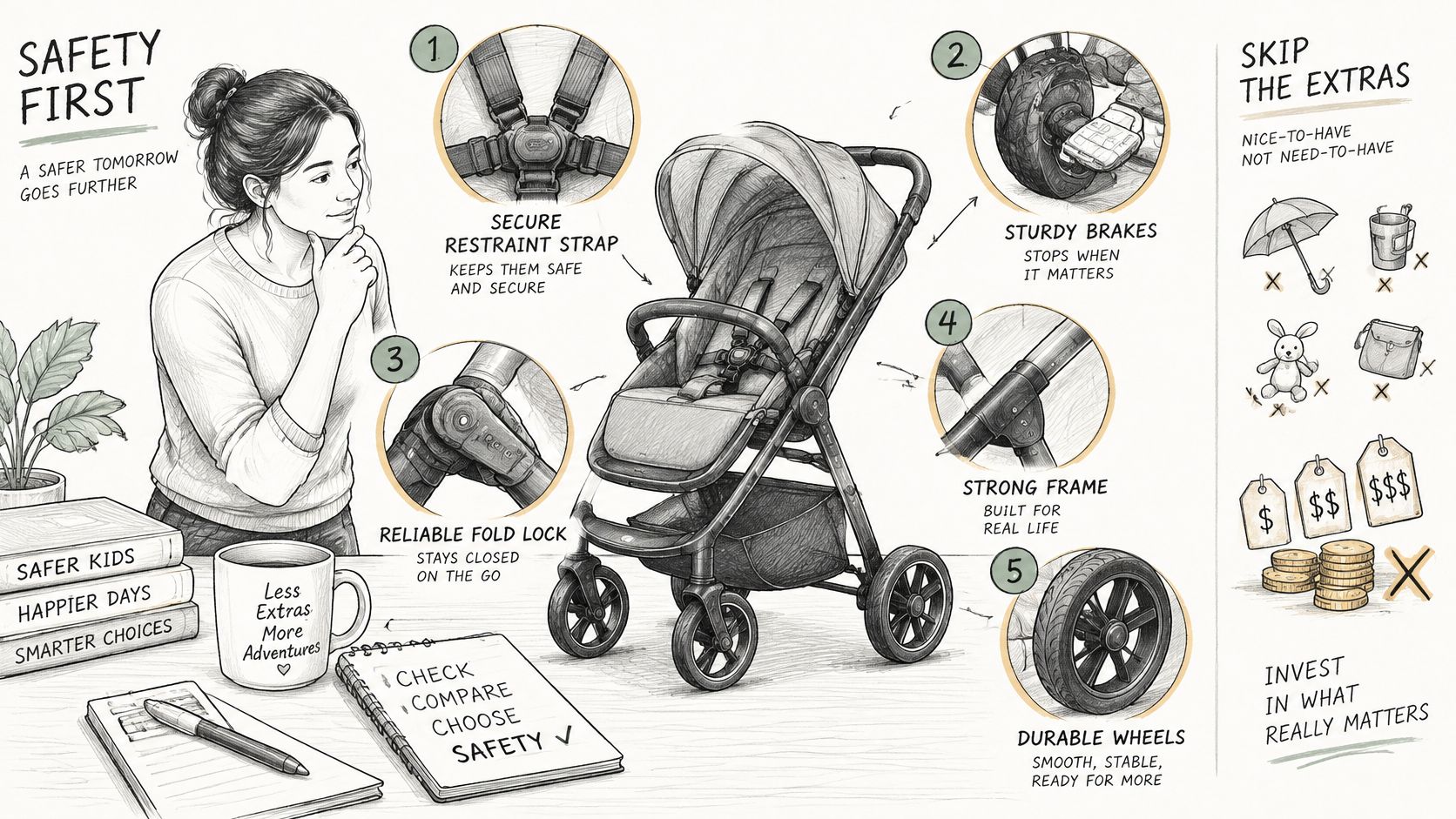
Spend on secure restraint, dependable brakes, positive locking and a stable frame before decorative extras. Among models that pass those requirements, pay for the wheel performance and handling needed on the daily route.
A larger canopy or a colour upgrade can be worthwhile, but neither compensates for awkward braking or a stroller that cannot be lifted into the car. Compare documented specifications alongside the seller's own posted price, including the contents of the package.
This illustration separates essential mechanisms from optional accessories.
Compare the complete purchase
A lower headline price may exclude the configuration needed immediately. List required components before deciding which model costs less.
- Newborn equipment: Include the approved carrycot, lie-flat configuration or necessary adapters.
- Weather accessories: Establish whether a suitable rain cover is included and how it attaches.
- Storage extras: Check whether a liner improves cleaning or merely consumes usable basket space.
- Usable lifespan: Consider how soon the child may reach the seat's stated limits.
A second-hand model can be good value only when its identity, condition and approved components are clear. Budget for necessary replacement parts before comparing it with a new model, and don't treat an improvised repair as a saving.
Budget priority: Meet the safety requirements, select a model that handles the daily journey, then decide whether the extras justify the remaining spend.
An inexpensive stroller with unclear compliance may become wasted money if it has to be replaced. A more expensive model can also be poor value if its extra size, weight or accessories make routine use harder.
Confirm Your Shortlist Before You Buy
Check identity, recall status and configuration
Confirm the exact model name, configuration and production information. Match the frame label with the manufacturer's documentation, including any carrycot, car seat or adapter being purchased.
Search official product-safety listings using that exact identity. The UK government's product-safety database included reports for the HLX Baby Stroller, Jiawababy Baby Stroller 608-A and Kidilo Baby Stroller with Car Seat, all dated 8 January 2025. These are specific model reports, not a reason to judge every product carrying a similar brand name.
Compare the surviving models against the safety checklist. If compliance cannot be established for the intended configuration, leave the model off the list regardless of its advertised features.
Keep a usable decision record
- Record the finalists: Save the model identifiers, documented limits, included accessories and seller pages. The Comredix product comparison chart provides a starting point for side-by-side comparison.
- Keep the paperwork: Store the checklist, manual and receipt together, photograph the product label and complete product registration so later notices can be matched accurately.
- Separate selection from proof: Comredix is an independent reviews publication using documented information, not a substitute for examining the stroller being sold.
Comredix's Kids & family category covers baby gear, toys, apps and services for parents and children, with 4 rankings.
Before paying, bring the shortlist to the retailer and run the in-store test on the exact model.
Comredix compares products using documented features and published prices, helping families separate useful equipment from optional extras. Visit Comredix to compare family products, then take the shortlisted stroller's specifications and safety checklist to the shop before buying.
Spotted an error in this guide? Email editorial@comredix.com