Studio note · General
Auto Loan Lenders Compared: Rates, Terms and Fees
Compare auto loan lenders by rates, terms, eligibility and fees. Learn when dealer or direct financing fits, and how prequalification can help you save.
- Updated
- November 20, 2026
- Reading
- 14 min
Which auto loan lender is cheapest for you? Most comparisons answer a different question. They rank advertised APRs, which are reserved for the strongest credit tiers, and skip what decides the cost: how long the loan runs, who is allowed to apply, what the lender charges beyond interest, and whether the published rate is a quote or an illustration.
This comparison reads every lender on the same four documented criteria: loan terms, eligibility, fees and published rates. The trade-offs then sit side by side instead of inside ten marketing pages.
The ten options fall into groups that behave differently. Dealer-linked banks, Bank of America and Chase, price through franchised dealers. Credit unions, PenFed, Navy Federal and Consumers Credit Union, gate access through membership. LightStream lends without touching the vehicle title. myAutoLoan is a marketplace, not a lender. Capital One Auto Navigator and CarMax Auto Finance tie financing to specific shopping channels, and USAA covers private-party purchases. The market structure explains why they don't compete on identical terms: in the first quarter of 2025, banks held 29.1% of U.S. auto-loan balances, credit unions 23.7% and captive lenders 21.1%, according to Mercer Capital's auto finance overview.
Two rules govern everything below. Advertised rates assume strong credit, and prequalification is an estimate, not an offer.
Table of Contents
- 1. Capital One Auto Navigator
- 2. LightStream by Truist
- 3. Bank of America Auto Loans
- 4. Chase Auto
- 5. PenFed Credit Union
- 6. Navy Federal Credit Union
- 7. USAA Auto Loans
- 8. myAutoLoan
- 9. Consumers Credit Union Auto Loans
- 10. CarMax Auto Finance
- How the 10 auto loan lenders compare
- Choosing an Auto Loan Lender in a Practical Sequence
1. Capital One Auto Navigator
Capital One Auto Navigator starts with a soft credit inquiry and ends in a dealership finance office. In between, it shows estimated rates and payments on specific cars at participating dealers, so the number on screen belongs to a vehicle rather than a generic rate table.
That estimate is a starting position, not a verdict. Experian puts the prime band for auto financing at 661 to 780 and notes that lenders still weigh income, debt, down payment, vehicle age and loan term, which makes any score cutoff a pricing indicator rather than a promise of approval, as Experian's credit score guide for auto loans explains.
The estimate moves when the shopper changes the vehicle, the down payment or the term.
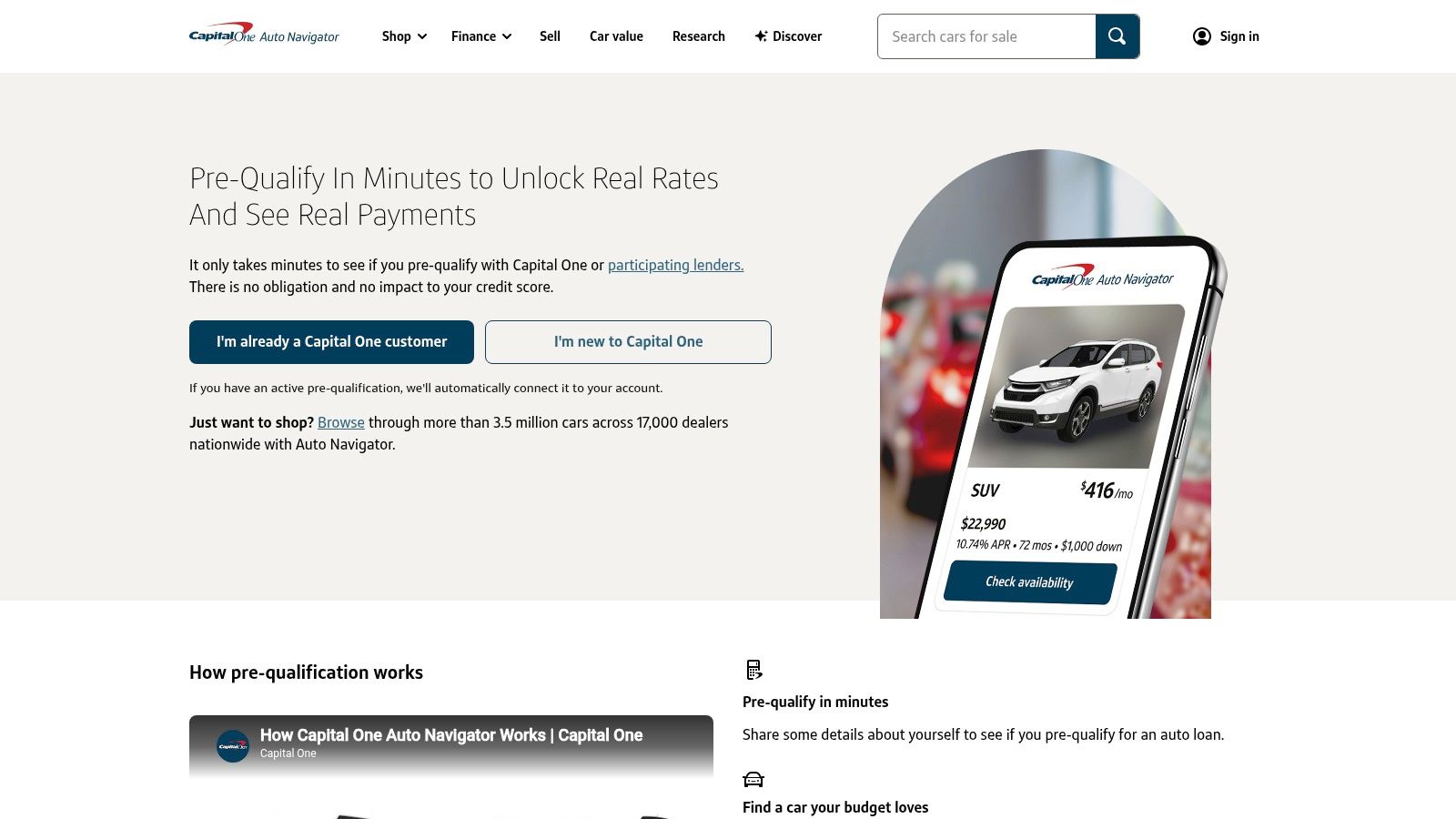
- Soft pull up front. Checking prequalification doesn't affect a credit score.
- Vehicle-specific figures. Estimates apply to eligible cars at participating dealers, not the whole used market.
- No banking relationship needed. A Capital One deposit account isn't a precondition to start.
- Adjustable inputs. Down payment and term can be changed to see the effect on the payment.
Finalizing the loan requires a hard credit inquiry, and the terms can shift after a full application. Financing is limited to eligible vehicles at participating dealers, which rules out private-party sellers and out-of-network lots.
Start at Capital One Auto Navigator.
2. LightStream by Truist
LightStream sells a personal loan, not a car loan, and that single difference explains most of its terms. The vehicle isn't collateral, so LightStream states no age, make, model or mileage restrictions and sets no down payment requirement for a vehicle purchase.
The cost test is straightforward. A secured loan is the benchmark: Experian reports an overall average APR of 6.35% for new-car loans and 11.19% for used-car loans in the second quarter of 2026, per Experian's auto loan rate data. An unsecured loan has to beat those numbers to be worth the added flexibility. When the personal-loan APR lands above the secured average for the same vehicle, the flexibility is the only thing being bought.
Where it earns a place: an older vehicle, a private seller, or a title a conventional lender won't accept as collateral.
- No listed vehicle restrictions. Age, make, model and mileage aren't stated limits.
- No loan fees or prepayment penalties. Its FAQ lists none.
- Autopay discount. A rate reduction may apply with automatic payments.
- No lien on the title. The borrower holds a clean title throughout.
Approval, rate and amount still depend on credit and the rest of the application, and the lowest advertised rate isn't available to every borrower. Compare the final personal-loan APR against a secured offer from a bank or credit union before signing.
Apply at LightStream auto loans.
3. Bank of America Auto Loans
Bank of America publishes example rates plus a payment calculator rather than one headline APR. That format is more useful, because each example carries a credit tier and term. The tier gap is the cost driver: Experian's second-quarter 2026 data puts average new-car APRs at 4.41% for scores of 781 or higher and 16.11% for scores of 300 to 500, as Experian's rate-by-credit-score table shows.
Eligibility runs through the dealer channel. Financing is arranged with eligible dealers and remains subject to vehicle and borrower requirements, so a private-party purchase sits outside the offer. On terms, eligibility, fees and published rates, the practical comparison is the final APR after any Preferred Rewards reduction against another preapproved offer.
- Published examples. Rate examples give a starting estimate before shopping.
- Preferred Rewards discount. Eligible existing customers may receive an interest-rate reduction.
- Payment calculator. Monthly figures can be modelled across terms.
- Dealer channel. Applications move through participating dealerships.
The limits are the usual bank ones: example APRs are illustrations rather than quotes, and the lowest rates sit with strong credit and shorter terms. Judge the offer on the four checks used for Bank of America Auto Loans: terms, eligibility, fees and published rates.
Get the rate sheet at Bank of America auto loan rates.
4. Chase Auto
Chase Auto's strongest feature is a prequalification screen that runs on a soft pull and asks for no Chase account. Purchase loans and eligible refinancing move through the same application flow, so a borrower can check terms for either purpose before committing.
The refinance side is timely. A Federal Reserve staff note on consumer delinquency dynamics found the seasonally adjusted auto-loan delinquency rate broadly stable from early 2024 through the second quarter of 2025, then up 5 basis points in the third quarter of 2025, the largest quarterly increase since the first quarter of 2024, with the deterioration concentrated in low-income Census tracts at about 70 basis points. For borrowers whose payments have grown harder to carry, a soft-pull refinance estimate shows whether a lower rate is on the table without touching a credit score.
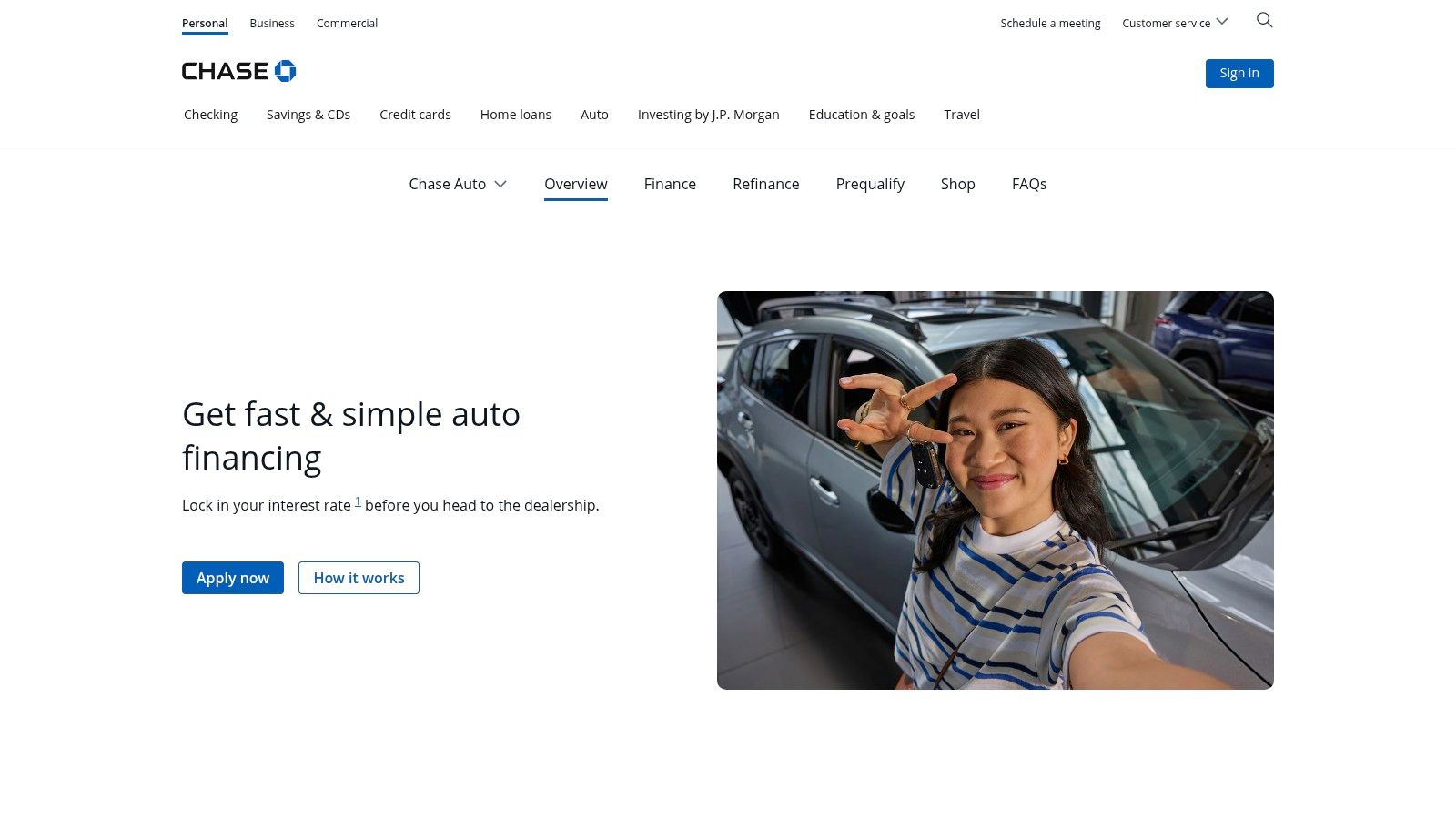
- Soft-pull prequalification. No Chase account is required to see an estimate.
- Purchase and refinance. Both purposes sit in the same application flow.
- Online application discount. A rate reduction may apply when applying online.
- Published rate examples and calculators. Useful for early comparisons.
Two limits sit on the eligibility side. Purchase money only moves through participating dealers, so a car bought from an individual seller has to be financed elsewhere. And the prequalification figure is an estimate, not a guaranteed offer: final terms depend on the dealer application and underwriting, which is where the actual rate gets set.
See the terms at Chase Auto finance.
5. PenFed Credit Union
PenFed publishes the broadest loan menu in this group: new cars, used cars and refinancing, plus a car-buying service through TrueCar and financing above the vehicle's value, subject to approval. That last option is the one to read carefully. Financing above value is how negative equity gets carried forward.
The numbers behind that risk are documented. The Congressional Research Service brief on auto loan affordability records an average new-car loan term of 69 months in 2025, and a 29.3% negative-equity share among new-vehicle trade-ins in the fourth quarter of 2025, the highest since the first quarter of 2021. A long term on an upside-down loan is a debt that outlives the car.
Financing above value doesn't remove negative equity. It moves it to a later date.
- Three loan purposes. New, used and refinance loans share one application.
- TrueCar buying service. Vehicle shopping and financing sit in one place.
- Up to 125% of value. Useful for taxes, fees and negative equity, subject to approval, per PenFed's auto loan page.
- Join while applying. Nonmembers can start the application and open membership in the same process.
Prequalification runs on a soft pull, but advertised low rates require strong credit and specific terms. Full approval takes a hard inquiry, and membership plus underwriting requirements apply.
6. Navy Federal Credit Union
Navy Federal's most useful published detail isn't a rate. It's the preapproval window, which gives a shopper a fixed budget for the length of a normal car search. The credit union also publishes APR tables by loan term, so the cost of stretching a term is visible before an application.
Service scores alone won't tell you which member got the better deal. J.D. Power's 2025 Automotive Financing Satisfaction Study recorded an average score of 743 out of 1,000 among financially healthy borrowers against 593 among financially vulnerable borrowers, a 150-point gap, with vulnerable customers making up 29% of the 13,150 surveyed, according to the J.D. Power study release. Rankings that don't segment by payment stress flatten that difference.
A published APR table shows where a longer term starts to cost real money.
- Purchase and refinance. New- and used-car loans plus refinancing from one lender.
- Military rate discounts. Eligible active-duty and retired members may qualify.
- Defined preapproval period. Preapprovals are generally valid for 90 days, per Navy Federal's auto loan page.
- Published APR tables. Rates are listed by term rather than a single headline.
Membership eligibility is the hard gate, and it excludes many consumers outright. The lowest advertised rates assume excellent credit and eligible vehicles, and longer terms raise total interest even when the monthly payment falls. Comredix's Navy Federal auto loan review applies the same four criteria to the offer.
7. USAA Auto Loans
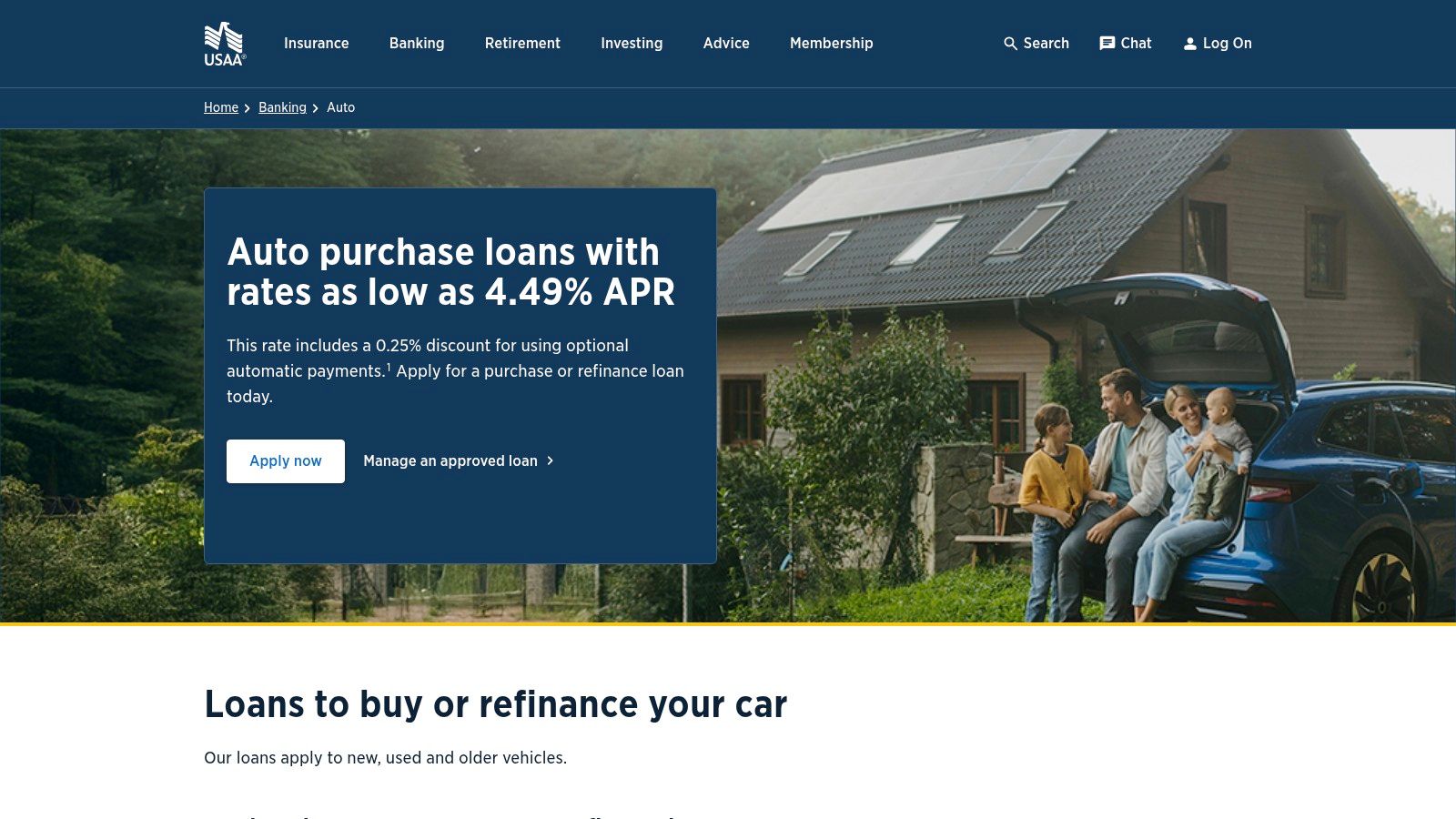
USAA finances purchases that many banks refer elsewhere. Dealer purchases, private-party sales, older vehicles and some lease buyouts sit inside its purchase and refinance menu, which makes it one of the few conventional lenders that will write a loan on a car bought from an individual seller.
The membership gate decides everything. USAA lending is restricted to eligible military members and their families, so the rate tables are irrelevant to anyone outside that group. Check eligibility before spending time on the numbers.
Run the qualifying test first. A competitive rate behind a membership wall isn't a comparison point, it's a dead end.
- Private-party financing. Covers purchases outside a dealership.
- Refinancing and lease buyouts. Some lease buyouts qualify alongside standard refinancing.
- Automatic-payment discount. An optional 0.25% reduction may apply with autopay, per USAA's auto loan terms.
- 45-day approval window. Approved loans are generally valid for 45 days.
Fees are thin on the ground: no application fee and no early-payoff penalty is listed. Some dealer add-ons, including GAP coverage, can't be financed through the loan, so that cost has to be paid separately.
8. myAutoLoan
myAutoLoan doesn't lend. One application goes to a network of participating lenders, which return as many as four offers across new, used, refinance, private-party and lease-buyout financing. The platform works as a comparison tool as much as a marketplace, and the identity of the lender behind each offer is the first thing to read.
Lender type changes the outcome more than the advertised rate does. Federal Reserve research found 10% of buy-here-pay-here loan balances delinquent in the third quarter of 2025 against 3.8% for traditional auto lenders, and put buy-here-pay-here delinquency and default at 2.65 and 1.88 times the traditional rates, as the Federal Reserve note on buy-here-pay-here auto lending reports. An approval is only as good as the channel behind it.
The offer list is not static. It shifts with the application, the loan purpose and the state where the borrower lives. On a marketplace, the four assessment criteria move with the lender: terms, eligibility rules, fees and published rates all come from whichever lender issues each offer, so two applications with different inputs can return different results.
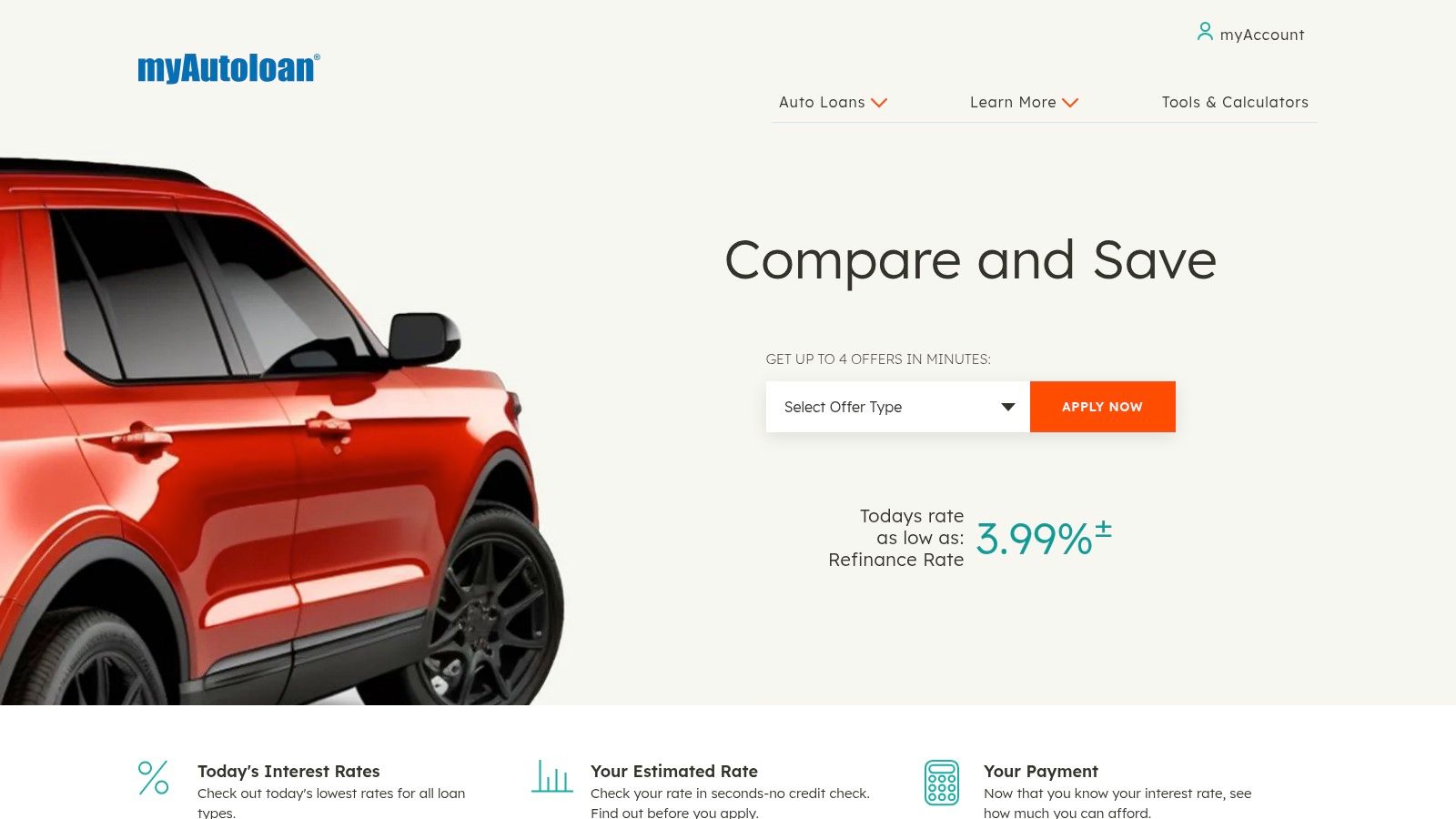
- Up to four offers. One application, multiple lenders.
- Five loan purposes. New, used, refinance, private-party and lease buyout.
- Rate charts and calculators. Directional pricing before an application.
- Lender-set terms. Each participating lender applies its own approval rules.
The limits follow from the model. myAutoLoan is not the lender, the lowest listed APR is a starting point that no applicant is guaranteed, and the number of offers depends on the application and the location. Comredix's myAutoLoan review applies the same quality, experience and value weighting the publication uses across its rankings.
Compare offers at myAutoLoan.
9. Consumers Credit Union Auto Loans
Consumers Credit Union accepts an application with an ITIN as well as a Social Security number, which puts it in a small group of auto loan lenders open to borrowers without standard documentation. New- and used-car loans can be started directly or through partner dealerships concentrated in Michigan and Indiana.
Where access is broad, the pricing carries the risk. A Federal Reserve Bank of Philadelphia analysis reported the seasonally adjusted share of auto loans at least 60 days past due reached 1.68% in the third quarter of 2025, the highest since 2008, while borrowers with credit scores below 620 at origination held only 17% of active accounts yet accounted for nearly two-thirds of delinquent loans, per the Philadelphia Fed report on auto loan delinquency. A lender that accepts thinner files prices for that concentration.
Regional borrowers can compare a direct offer with dealer financing on the same lot.
- Two application routes. Direct, or through a participating dealer.
- No prepayment penalty listed. Early payoff doesn't carry a fee.
- ITIN applications. An alternative to a Social Security number.
- Credit Smart Program. Support for applicants who struggle to qualify.
Geography is the practical limit. Membership and residency requirements restrict who can borrow, dealer partnerships are concentrated in two states, and rates depend on credit and vehicle details.
See the terms at Consumers Credit Union auto loans.
10. CarMax Auto Finance
CarMax Auto Finance is a captive lender with one job: financing cars sold by CarMax. Online prequalification uses a soft credit inquiry and returns a personalized estimated APR, payment and down payment before a full credit application, which makes affordability visible while browsing the lot rather than after the test drive.
Convenience is the entire pitch, and it's a real one. The restriction is that a shopper who finds a better car elsewhere can't use the approval, and the figures that appear during prequalification can move once the full application is reviewed.
Bring an outside quote to the finance desk. A credit-union preapproval turns the final conversation into a comparison instead of a single take-it-or-leave-it offer.
- Soft-pull prequalification. Estimate terms without a credit-score impact.
- Personalized figures. Estimated APR, monthly payment and down payment.
- Integrated shopping. Financing sits inside the CarMax inventory search.
- Full application to finalize. A purchase loan isn't complete at prequalification.
Compare the CarMax offer against a bank or credit union quote before signing, especially on a longer term where the interest total diverges most from the monthly figure.
Review financing at CarMax Auto Finance.
How the 10 auto loan lenders compare
Each lender is screened against the same four documented criteria: loan terms, eligibility, fees and published rates.
| Lender | Loan purposes | Prequalification | Standout feature | Main limitation |
|---|---|---|---|---|
| Capital One Auto Navigator | Vehicle purchases at participating dealers | Soft-pull prequalification; terms are estimates | Browse eligible cars with estimated rates and payments | Final application uses a hard inquiry; eligible dealers and vehicles only |
| LightStream by Truist | Vehicle purchases and refinancing | Approval, rate and amount depend on credit and the full application | Unsecured loan with no stated vehicle age, make, model, or mileage restrictions | Personal-loan rates may exceed secured auto-loan rates |
| Bank of America Auto Loans | Vehicle purchases through eligible dealers | Example rates and a payment calculator before applying | Preferred Rewards members may qualify for rate discounts | Dealer and vehicle restrictions may apply |
| Chase Auto | Vehicle purchases and eligible refinancing | Soft-pull prequalification; estimate only | Online rate information and payment calculators | Purchase financing requires a participating dealer; no private-party purchases |
| PenFed Credit Union | New and used vehicle purchases; refinancing | Soft-pull prequalification | Car-buying service through TrueCar | Membership and underwriting requirements apply |
| Navy Federal Credit Union | New and used vehicle purchases; refinancing | Preapprovals generally valid for 90 days | Military-related rate discounts may be available | Membership is limited to eligible consumers |
| USAA Auto Loans | New, used, and older vehicle purchases; refinancing; some lease buyouts | Approval generally valid for 45 days | Dealer and private-party purchases; optional autopay discount | Membership is restricted to eligible people |
| myAutoLoan | New and used vehicle purchases, refinancing, private-party purchases, and lease buyouts | One application may return up to four offers | Compares offers from participating lenders | Marketplace rather than a direct lender; number of offers depends on the application, loan purpose and state |
| Consumers Credit Union Auto Loans | New and used vehicle purchases | Applications start directly or through a partner dealer | Accepts applications with an ITIN or Social Security number | Geographic and membership eligibility may limit access |
| CarMax Auto Finance | Vehicle purchases through CarMax | Soft-pull prequalification; estimates may change | Financing integrated with CarMax vehicle shopping | Financing is limited to CarMax purchases |
A strong standout feature still loses if the limitation blocks the purchase.
Choosing an Auto Loan Lender in a Practical Sequence
Eligibility decides the field before rates do. Each lender in the ranking is assessed on the same four documented points: loan terms, eligibility, fees and published rates. Applied in a practical order, they cut wasted applications fast. Three of the ten options are closed to most readers before a single number matters: Navy Federal and USAA restrict membership, and Consumers Credit Union limits geography. Chase, Bank of America and Capital One route purchase loans through participating dealers, so a private-party purchase rules them out.
Next, collect soft-pull prequalifications from what remains. They cost nothing in credit-score terms at Capital One, Chase, PenFed, Navy Federal, CarMax and myAutoLoan, and each one converts an advertised rate into a number attached to a term and a vehicle. Store every estimate in one place. Comparisons only hold when each offer prices the same loan amount, the same term and the same vehicle, rather than whatever figure a dealer quotes in the room.
Then compare the total cost of each offer. The monthly payment hides the trade: a longer term lowers it while raising both the interest bill and the stretch where the balance exceeds the vehicle's value. For each offer, calculate the total interest and the principal remaining after 24, 36 and 48 months, then find the resale value at which the payoff and the car's worth meet. That stretch is where negative equity starts, and it is why the cheapest monthly figure is rarely the cheapest loan.
Fees belong in the same calculation. Ask for origination, documentation, title and prepayment charges in writing and add them to the total. A loan carrying a lower rate and a 1% origination fee can lose to a slightly higher rate with none.
Hold the decision until competing hard-pull offers can be compared inside one short shopping window, so the inquiries read as a single event. Approve nothing until at least one bank or credit-union offer, one dealer offer and, where relevant, one marketplace offer sit on the table together.
Comredix's Money category ranks banking, card, budgeting and investing products, each scored on quality at 40 percent, experience at 25 percent and value at 35 percent from published documentation rather than hands-on testing. The methodology and editorial policy pages at Comredix show how each score is built. Read them before requesting a single prequalification.
Spotted an error in this guide? Email editorial@comredix.com